
Over 4, 000 total knee replacements have been completed in the U.S. using OMNIlife Science, Inc.’s OMNIPlasty technique.
OMNIPlasty Tops 4, 000 Total Knees
2 min read Premium comments
Secondary
Total Knee Procedure

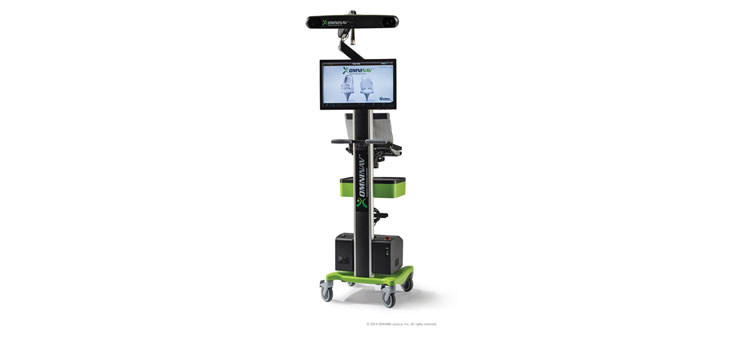
OMNI’s system performs a total knee procedure that uses robotics utilizing the company’s OMNI ART software platform. Surgeons can plan and execute a procedure that is specific to each patient using a patented intra-operative 3-D modeling technique that is not dependent on pre-operative CT scans or X-rays.
Jan Koenig, M.D., of Winthrop University Hospital in Long Island, said in a September 15, 2014 company press release that the OMNINAV station “has the look and feel of the future in orthopedic navigation, which is validated by its extreme level of performance and accuracy.” Koenig add that “OMNIPlasty offers the only robotically assisted total knee replacement technology on the market, which provides my patients with a custom-tailored solution for their knee arthritis problems.”
Which begs the question, how exactly is OMNI’s robotic system different from other systems on the market?
Different From Blue Belt and MAKO
George Cipolletti, the president and CEO of OMNI told us that the company’s OMNINAV platform is different from the other solutions in several areas.
First, he says it is the only system that performs robotically assisted surgery for total knee replacement, which accounts for 10 times the number of procedures worldwide compared to partial knee replacement (addressed by MAKO/Stryker Corporation and Blue Belt Technologies, Inc.).
“Our hardware platform has a small footprint in the operating room and requires no turnaround between cases, compared to an hour or two for other systems.”
Second, he notes that OMNIPlasty uses patented bone morphing technology which is the software that allows a complete 3-D image of the knee to be created intraoperatively without X-rays, while the competitive systems require expensive CAT or MRI scans prior to surgery. “Our OMNINAV system implants world-class knee devices with a proven clinical track record of better than 99% survivorship over eight years for tens of thousands of cases.”
No Charge!
Finally, he says “we have a much more cost-effective solution for the hospital, placing OMNINAV stations at no cost to the hospital. The other systems charge from $450, 000 to $1, 000, 000+ per installation.”
The OMNI ART software, says the company, is designed for flexibility and customization to any surgeon’s particular philosophy, which may result in increased efficiency. Corey Ponder, M.D., from Oklahoma Sports & Orthopedics Institute in Oklahoma City states, “The flexibility we have achieved using OMNI ART software is significant. When changes need to be made during surgery because of unforeseen circumstances, we are able to handle them easily and efficiently. When you combine that time savings with the robotic precision of OMNIPlasty, you have then taken total knee replacement to another level.”
Privately held OMNI was founded in 1999 and is located in East Taunton, Massachusetts.
Author
React:
Discussion
This is a fascinating development. In my practice we've seen similar outcomes with the revised protocol. The key differentiator seems to be patient selection criteria. Has anyone else noticed the correlation with BMI thresholds?
Great point. I'd push back slightly on the conclusion, the sample size in the cited study is too small to draw population-level inferences. That said, the directional signal is compelling and worth a larger RCT.
We implemented a similar approach last year. Early results are promising but we're still gathering 12-month follow-up data. Happy to share our protocol if anyone is interested.
Join the conversation
Orthopedic professionals are discussing this. Sign in and upgrade to read every comment and add your voice.