
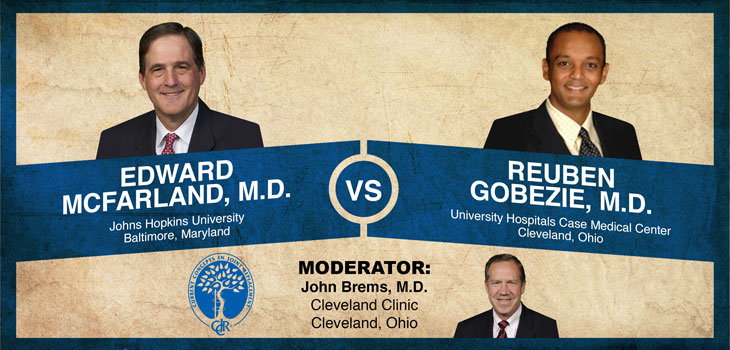
This week’s Orthopaedic Crossfire® debate is “This Infected TSA Is Best Treated With a Primary Exchange.” For the proposition is Edward McFarland, M.D. of Johns Hopkins University. Against the proposition is Reuben Gobezie, M.D of the University Hospitals Case Medical Center. Moderating is John Brems, M.D. of the Cleveland Clinic.
McFarland, Gobezie Debate Treatment for Infected TSA
7 min read Premium comments
Great Debates
Dr. Brems: “This case involves a 66-year-old retiree who is five weeks after what was deemed to be an uncomplicated total shoulder replacement with cemented implants on both sides of the joint. He has had chronic pain at rest and during the night, the latter of which has been present since week two postop, and has interfered with the quality of his sleep. He’s had sed rate, CBC, and white count studies, all of which are unremarkable. The joint was positive for Propionibacterium acnes (P. acnes) at eight days.”
Dr. McFarland: “I predict that in the future we’re going to see more and more P. acnes infections in the lower extremity as cultures are taken out further. I’m a bit older than Dr. Gobezie and I don’t want to rain on his parade, but there are certain things that you just don’t do.”
“So is this patient really infected? Probably. The big issue with P. acnes is that it’s often a contaminant. And while it’s not a very aggressive microbe it can still result in pain, loosening and failure.”
“You could do nothing and just watch it. You could use suppressive antibiotics. You can remove and put in a spacer or you could do a one-stage revision where you remove the components and re-implant them with antibiotic cement. Or you can do a two-stage revision with an intervening operation.”
“There is no guidance from the literature about options for this patient as far as debridement alone versus primary exchange. But I think we can piece together an algorithm that makes sense for this patient.”
“There are a lot of factors we use to determine how aggressively to treat a patient. We need to know how symptomatic they are…if the patient experiences pain at rest then it’s worrisome. It’s unclear whether it’s his dominant or nondominant arm; is he active or is he a couch potato? If the goal is to eradicate the infection, I think all of us would agree that the best way to do this is by removing the prostheses, including the glenoid and the humeral side. In this case the radiographs didn’t show much cement.”
“Once the prosthesis is out you can put in a spacer. You can do a one- or two-stage revision. We did a systematic review of the literature and found 19 English-language studies with a minimum 12-month follow-up. We compared the re-infection rates, complication rates, and satisfaction rates. But we found no statistical difference between the three groups. This is because all of the studies were Level 4, and as a result we have struggled to get it published.”
“The standard of care for knee and hip arthroplasty for an infected joint seems to be a two-stage revision—except in the first six to eight weeks when it’s probably fine to just debride the joint. For an infected total shoulder in the U.S. (one with an aggressive organism), the answer is probably two-stage revision. If this patient grew MRSA I would take it out, put in a spacer, and revise at a later date. With P. acnes it’s less obvious because sometimes we’re not sure if it’s an infection or a contaminant.”
“With this patient, since it’s less than six weeks, I would give him the option of IV antibiotics for six weeks followed by oral antibiotics for at least six months. If he then showed signs of progressive loosening then I’d remove it and do a two-stage revision. If the patient was very sick I would do a one-stage revision. I don’t think debridement would add much. You might try it arthroscopically, but in total shoulders if you remove the sphere in the early period the stem usually comes out with it and you’re faced with revising the whole thing. If the humeral stem came out I would remove the cement and the glenoid and put in a spacer; then I would re-implant a reverse total shoulder arthroplasty [TSA] at the second stage because many of these patients go on to have subscapularis failure.”
“So, for patients who are even a bit ill, I would do a one-stage revision. I would consider resection arthroplasty or a spacer alone. If the person was young and healthy then I would do a two-stage revision.”
Dr. Gobezie: “The history of chronic pain is important. This person is only five weeks out, has a benign wound, and normal X-rays. Standard postop pain could be the problem…or metal allergies…or cervical radiculopathy, pain syndromes, or an overly aggressive physical therapist. It’s not clear that this patient is infected.”
“Shoulder infections after arthroplasty range about 1.3% for hemis; for totals anywhere from 0-3.9%. For reverses it is slightly higher. The most common organism is P. acnes, but you also have Staph epidermidis and aureus. P. acnes is a slow growing anaerobic, gram-positive bug whose symptoms are subtle; diagnosis is almost purely clinical. It has a sensitivity and specificity of aspirate that is sub-optimal and is very difficult to grow.”
“There is no gold standard for assessing whether or not someone has a shoulder infection after an arthroplasty. White blood cell count is often normal. Interleukin-6, while touted as a good tracker for infection after debridement, is not a good test for diagnosis. C-reactive protein (CRP) has a low sensitivity and a high specificity, and the erythrocyte sedimentation rate has low sensitivity and high specificity.”
“Earlier this year John Sperling published a paper on polymerase chain reaction (PCR) coupled with mass spectrometry for the analysis of synovial fluid using P. acnes ribonucleic acid (RNA). I think this is the future. The sensitivity is 81% and the specificity is 95%…much superior to anything else for shoulder infections.”
“Assuming this person has an infection, none of the treatments are great. Antibiotic suppression has a failure rate from 60-75%. Debridement with retention of the prosthesis—which is what we’re proposing—has a failure rate of up to 50%. Resection arthroplasty does provide good pain relief, but very poor function. Arthrodesis is suboptimal.”
“When is it appropriate to retain a prosthesis and do a debridement? Most papers support less than 30 days from implantation as an acceptable period—or, with less than three weeks of symptoms. The question in this case is that we don’t know when the symptoms started.”
“Let’s start with a non-replaced shoulder that’s infected. There is a case report from last year of 50 consecutive cases of septic arthritis treated with debridement and irrigation. Most of the organisms were Methicillin-sensitive Staphylococcus aureus (MSSA), and repeated irrigations were required in 30% of cases. They were otherwise treated successfully.”
“Another report looked at 19 shoulders that had an average symptom duration of three weeks. Staph aureus was the most common bug, and 14 of the 19 were successfully treated with one lavage.”
“There are no papers on wash out for prosthetic shoulders. However, there was a paper published this year in Arthroscopy looking at knee replacements that were infected, and tracking CRP levels as a means of determining whether or not eradication was achieved. Of all cases, 63% were treated successfully; the remaining six cases required open debridement with poly exchange.”
“Another paper looked at a lavage protocol in total knees; there were five cases and less than seven days of symptoms. We don’t know when the symptoms started. A 36-month follow-up showed that none of the knees needed to be washed out again, and no patients required oral suppressive antibiotics. So early, aggressive treatment was an effective option.”
“If you’re going to do anything to this patient, I think it would be reasonable to do an arthroscopy debridement at the most before you rip their arm out (like Ed would like to do). In theory, doing the arthroscopic debridement will allow you to get the synovial tissue samples that you could submit for the PCR mass spectrometry. That would give you a much more accurate diagnosis. If anything, we should treat the lab technician, who is probably infected.”
Moderator Brems: “Ed, what risk does waiting place on the glenoid interface?”
Dr. McFarland: “One advantage is that if it’s loose it’s easier to remove.”
Moderator Brems: “If you do any exchange what do you do with the glenoid component?”
Dr. McFarland: “Theoretically, if you’re going to do an exchange then you have to take everything out. I didn’t see a lot of cement in the stem shaft in this case. That’s a game changer because it increases the complexity.”
Moderator Brems: “Reuben, what about comorbidities (diabetes, hypothyroidism, etc.)?”
Dr. Gobezie: “With a type C patient there would probably be a lower threshold for aggressive treatment. We don’t know the patient like you do, and most of us can size up how reliable a historian the patient is.”
Moderator Brems: “If you ‘wait and see, ’ would the presence of other joint arthroplasties within that patient affect your decision?”
Dr. McFarland: “Septic shoulders tend not to create sepsis. With infected shoulder replacements I’ve never seen any patients seed other joints. I’ve never seen a P. acnes patient get septic.”
Moderator Brems: “Have you ever done arthroscopic lavage of a regular arthroplasty?”
Dr. Gobezie: “No…just an open wash out.”
Moderator Brems: “When you do the cement spacer what antibiotic do you prefer?”
Dr. McFarland: “The commercially available ones.”
Dr. Gobezie: “I think the only time that arthroscopic lavage has been present in my practice is for a native shoulder…the infected person (type C host).”
Moderator Brems: “Thank you both.”
Please visit www.CCJR.com to register for the 2014 CCJR Winter Meeting, December 10 – 13 in Orlando.
React:
Discussion
This is a fascinating development. In my practice we've seen similar outcomes with the revised protocol. The key differentiator seems to be patient selection criteria. Has anyone else noticed the correlation with BMI thresholds?
Great point. I'd push back slightly on the conclusion, the sample size in the cited study is too small to draw population-level inferences. That said, the directional signal is compelling and worth a larger RCT.
We implemented a similar approach last year. Early results are promising but we're still gathering 12-month follow-up data. Happy to share our protocol if anyone is interested.
Join the conversation
Orthopedic professionals are discussing this. Sign in and upgrade to read every comment and add your voice.