
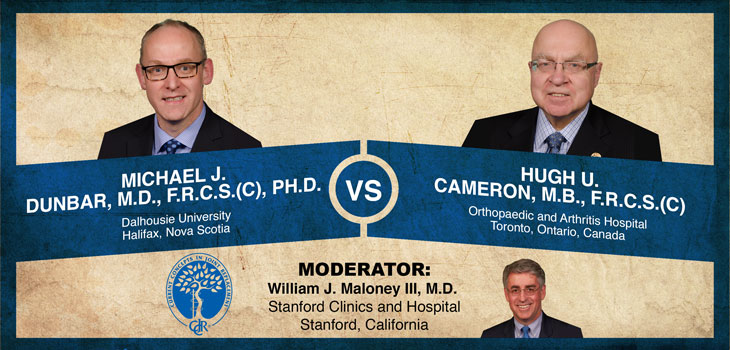
This week’s Orthopaedic Crossfire® debate is “Abandonment of Modular Necks: The Baby and the Bath Water.” For the proposition is Michael J. Dunbar, M.D., F.R.C.S.(C), Ph.D. of Dalhousie University in Halifax, Nova Scotia. Against the proposition is Hugh U. Cameron, M.B., F.R.C.S.(C), of the Orthopaedic and Arthritis Hospital in Toronto. Moderating is William J. Maloney III, M.D. of the Stanford Clinics and Hospital.
Dunbar, Cameron Debate Modular Necks
7 min read Premium comments
Great Debates
Dr. Dunbar: “There are three proposed advantages to modularity: reduction of impingement, reduction of dislocations, and better balancing of leg length and offset with subsequent improved function. As for impingement, it can be an issue if you use ceramics. And as impingement is related to femoral component positioning, your job is to get the component right.”
“The Australian Joint Replacement Registry (2013) shows that modular necks have a higher dislocation rate. With regard to leg length and offset, with a cemented stem you don’t need this because within the envelope you can broach it up and down, and change the varus and valgus; you can also play with the version. There are no advantages to the modular neck.”
“There is the potential for fretting and ion debris (and associated corrosion). There’s also dissociation and fracture. In my opinion, the midterm outcomes at 10 years are worse than fixed necks; they are also more expensive. A 2009 paper that won the John Charnley Award (Garbuz et al., The Association of Bone and Joint Surgeons) found that the issue wasn’t the metal-metal bearing, but the coupling. So there is the potential to generate metal ions.”
“A 2010 series on 5, 000 hips with a titanium neck had a fracture rate of 2.4% (Grupp et al., BMC Musculoskeletal Disorders). That’s not an extremely high rate, but it’s unacceptable. We reported on the PROFEMUR Z fractures at the tension interface of the modular neck (2010, The Journal of Bone and Joint Surgery). We have had over 452 implanted and had a fracture rate of 4.5%. These are big revisions because you can’t get them out the way you normally do because there is no neck to grab onto. You’re often forced to do extended trochanteric osteotomies. We now have patients with ‘time bombs’ inside of them and they are upset about it, and are in fact undergoing counseling.”
“The Australian Registry shows that the fixed neck has better survivorship than the modular neck. One reason that there may be a higher revision rate is due to retroversion. Gill from the Oxford lab (The Journal of Arthroplasty, 2002) looked at the effect of retroversion on radiostereometric (RSA) migration patterns. As you retrovert, you extend the lever arm thus generating more retroverting forces. This would be germane when you’re getting out of a chair, climbing stairs, etc.”
“Australian Registry data from 2012 shows reasons for revision in modular versus fixed necks, and there was a much higher incidence of aseptic loosening with the modular necks. This may in part be due to this retroverting effect.”
“Finally, these are expensive. Would the money have been better spent on surgical technique/training?”
Dr. Cameron: “The modular neck in most common use is the Cremascoli; the one I use is different, but has the same concept. All of the companies think that the bigger the stem, the longer the neck, but a big stem with a longer neck results in leg length problems.”
“The Rizzoli Institute researchers looked at this (The Journal of Bone and Joint Surgery, 2009) and found that without a modular neck it is not possible to recreate length, offset, and version…especially in women. Impingement is also an issue; it can cause dislocation, noise, particle generation, and locking mechanism failure. In the past I never heard bad things about the Cremascoli. What has changed?”
“The taper has been shortened, the neck is longer, the version angles have been increased, head sizes bigger than 32mm have been introduced, and there have been some surface changes.”
“The one I’ll discuss here is cobalt chrome, not titanium. It’s a standard Morse taper reinforced with anti-rotation cogs. It’s the R-120, a conventional stem with a proximal satin finish. Once the stem was in the neck length variation was a huge bonus, but the main advantage was version change. I can put it in 8 degrees and 12 degrees of version; more isn’t necessary.”
“It is possible to change version after stem insertion. You can’t use a pure Morse taper because it won’t withstand the rotational forces; that’s where the rotational cogs come in. The original cemented stem I used between 2002 and 2005 was polyethylene cemented sockets. The neck length was usually 32mm, but 35mm was also available, as was 38mm in a couple of cases. I anteverted it in only two cases; it was neutral in 39% of cases and retroverted in 59% of cases. This means that if the necks were not modular it would not have been possible to place them in the optimal position.”
“We had two bisphosphonate fractures and one late sepsis, as well as two taper fractures at the neck/stem junction and one taper dissociation. All had long necks and heads. The stem was reintroduced in 2007 and between then and 2011 I did 188 cases. All stems were cemented and all cups were not cemented. The early complications were six calcar fractures, all of which were wired. There was one dislocation at two years and zero taper problems. Neck version was even more surprising; almost none of them were anteverted. Less than 30% were neutral and about 75% were in retroversion. Some of these were in maximal retroversion, meaning that if the cup was nonmodular then I would have placed only 30% in an optimum position.”
“The taper problem has been solved. My caveat is that I’ve never used a head >32mm. In a series from 2002 I’ve done more than 350 cases with no incidents of delayed metal hypersensitivity and no pseudotumors. Columbus had problems finding America and Charnley had issues with his initial hip joint. My friends embrace the future!”
Dr. Dunbar: “I’m taking an international approach with all comers through registry data and he is showing his excellent series. He is better than the average surgeon, so it doesn’t reflect in his data.”
Dr. Cameron: “You must impact the taper. They must be put in properly, especially if it’s an offset taper. And you can’t just tap it a little bit. When you’re locking a taper the heaviest hit is the only one that’s important.”
Moderator Maloney: “Mike, Dr. Cameron said to get the offset leg length correct you must use a modular neck.”
Dr. Dunbar: “That’s the argument for a cemented stem. If the argument is that an old osteoporotic femur gets a big patulous canal, therefore I get a big stem with a big offset because that’s the linear scale up with the companies, the answer is, ‘forget the uncemented stem, put a cemented stem in and within the cement envelope you can put in any size offset and fine tune it.’”
Dr. Cameron: “The problem is that in North America residents aren’t taught cemented stems. And cementing a stem properly is much more difficult than locking a taper properly.”
Dr. Dunbar: “That would go to your point earlier about not being afraid of the taper. In the long term it won’t be acceptable to say that because we’re in North America and we haven’t taught our residents how to do cemented stems that we must abandon it and develop new technologies. We have technologies that have been around for 35 and 40 years. It seems that every time we introduce a new technology we mess it up.”
Moderator Maloney: “Hugh, you look at the registry data and it’s clear that modular necks are having problems. How do you respond to someone saying, ‘How can you justify using a modular neck when we’re having fractures, taper corrosion, and adverse local tissue reaction?’”
Dr. Cameron: “There are some tapers and stems available that aren’t very good. But in the Australian Registry, if you’re doing a revision and remove the neck, but leave the stem alone, then that’s counted as a revision.”
Moderator Maloney: “There are other ways to get around the version and neck angle issue. Don’t you think we have enough options without making it modular?”
Dr. Cameron: “I’ve been using S-ROM for 25 years and I could always change the version and the offset. But I couldn’t do it with a cemented stem.”
Moderator Maloney: “You’re both from Canada and have issues about who is paying. If payers are looking at this data, then what are they going to do with modularity?”
Dr. Dunbar: “I would restrict it to a single use individual case that is justified with a submission to Health Canada. At our center, the reason we put in a modular neck is that it was part of an RSA [Royal & Sun Alliance Insurance Company of Canada] study. It’s really hard to print the RSA study on 0.8 micromotion when we’re reporting a 5% fracture rate. The cost for the neck was more than the entire construct of the cemented hip that I use.”
Dr. Cameron: “We do more joints than any other hospital in Canada and I’m the only one who still uses cement on a regular basis. So when I’m gone I suspect this argument will go too.”
Moderator Maloney: “Are you going to fill out a form for your hospital administrator in order to use a modular neck?”
Dr. Cameron: “I already do.”
Dr. Dunbar: “There is a class action lawsuit over this in our province.”
Moderator Maloney: “Hugh, what about assembly?”
Dr. Cameron: “It must be done properly, especially if it’s offset because when you’re hitting it down you’re losing half the force. I wonder how many of these head/neck junction problems are because they’re not being hit hard enough. And it’s not as crucial to keep it dry in the body as it is to hit it hard.”
Moderator Maloney: “Mike, what about in vivo assembly?”
Dr. Dunbar: “It brings complexity and it’s just another variable that can go wrong.”
Moderator Maloney: “Thank you gentlemen.”
Please visit www.CCJR.com to register for the 2014 CCJR Winter Meeting, December 10 – 13 in Orlando.
Author
React:
Discussion
This is a fascinating development. In my practice we've seen similar outcomes with the revised protocol. The key differentiator seems to be patient selection criteria. Has anyone else noticed the correlation with BMI thresholds?
Great point. I'd push back slightly on the conclusion, the sample size in the cited study is too small to draw population-level inferences. That said, the directional signal is compelling and worth a larger RCT.
We implemented a similar approach last year. Early results are promising but we're still gathering 12-month follow-up data. Happy to share our protocol if anyone is interested.
Join the conversation
Orthopedic professionals are discussing this. Sign in and upgrade to read every comment and add your voice.