
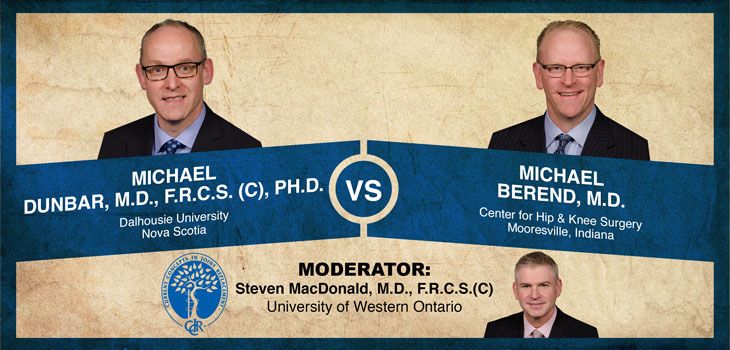
This week’s Orthopaedic Crossfire® debate is “The All Poly Tibia: Cheaper and Better.” For the proposition is Michael Dunbar, M.D., F.R.C.S. (C), Ph.D. of Dalhousie University in Nova Scotia. Against the proposition is Michael Berend, M.D. of the Center for Hip & Knee Surgery in Mooresville, Indiana. Moderating is Steven MacDonald, M.D., F.R.C.S. (C) of the University of Western Ontario.
Dunbar, Berend Debate the All Poly Tibia
7 min read Premium comments
Great Debates
Dr. Dunbar: “The all poly tibia is absolutely cheaper. Mike’s partner and mentor wrote a paper in 1994 saying that they are about 30% cheaper (Ritter). Another study—from 2007—suggested that it’s about $750 cheaper per case. Why? There has to be additional material, but also it’s the machining and engineering that goes into modular tibias to make these things work.”
“Residents may say, ‘Why are you guys so uptight about the locking mechanism?’ Well, this was a big deal in the past, and in the more recent past it’s been an issue with certain prostheses where the locking mechanism has failed. It generated significant backside debris and it created large bone voids in multiple series of patients. All of the subsequent design and machining has driven up the cost of modular implants.”
“A benefit of an all poly tibia is that because it does not have to mate to a metal component, for the same tibial resection you end up with more polyethylene. We know that if your poly is too thin and there is third body wear then you can get into runaway wear with significant complications.”
“Mike may say that we should use metal backed modular tibias because they result in easy revisions. This is false, and there is lots of data to support this. In a series from Mayo by Rob Trousdale et al., they reported on 56 isolated tibial exchanges. They said, ‘Isolated tibial insert exchange led to a surprisingly high rate of early failure. Tibial insert exchange as an isolated method of total knee revision should therefore be undertaken with caution even in circumstances for which the modular insert was designed and believed to be of greatest value.’”
“The reasons for early revisions are instability and infection, which poly exchange will likely not address. The reasons for late failure are aseptic loosening and poly wear. The only issue here is poly wear, and few surgeons are going to go back and exchange a polyethylene into a poor locking mechanism.”
“So are they better? There is a meta analysis from 2011 (Cheng, Tao, Acta Orthopaedica) saying that statistically, there is no difference in any of these studies between metal backed and all poly tibias. But they did find significantly more lytic lines in the metal backed group. I believe this relates to the RSA (radiostereometric analysis) data.”
“There are multiple RSA studies looking at these two constructs. A 2005 study from Hyldahl (Acta Orthopaedica) was a randomized controlled trial comparing 20 all poly and 20 metal backed. They found significant differences in the RSA migration patterns, with the metal backed being the worst and having the most subsidence over time. Why is that?”
“Another RSA study looked at 11 metal backed and 10 all poly and found the same problem with subsidence. The issue is that under asymmetrical load if you subside with a central keeled tibial component with a high modulus, then you’re going to get liftoff on the other side. And when you have a monoblock all poly tibial component it’s not going to lift off…it’s going to deform instead under that same asymmetrical load—and that may be protective. In fact, this is what they found in this data.”
“Data from the Kaiser Permanente registry included 27, 657 primary total knee arthroplasties (92% modular and 8% monoblocks). A hazard ratio less than 1.0 means that you have a favorable advantage (less likely to be revised). When they looked at all comers in the all poly group the hazard ratio was half (50% reduction in revision).”
“So, all poly tibias are cheaper and better—no backside wear, more poly for the same tibial resection, better RSA data, and better survivorship.
Dr. Berend: “The experience of your center and our publication of disastrous results with the all poly tibia with the AGC [anatomic graduatedcomponent] is either a poor reflection on us or on patient selection—or implant design. Proposed options for solving wear include improved locking mechanisms, a change in femoral material, using a mobile bearing type design, changing the poly formulation with cross linking or vitamin E.”
“There are advantages of the all poly tibia; for one, it is non-modular. The data show that less than 5% of us are willing to put in a non-modular implant, so we need to consider training and surgeon comfort issues.”
“Mayo Clinic has looked at just over 11, 000 TKRs [total knee replacement], examining patient and implant factors. They concluded that the most effective design in the long term was a non-modular, metal backed tibial component with cemented fixation with all poly patellar resurfacing and retention of the PCL (posterior cruciate ligament).”
“We’ve used the one piece AGC for nearly 30 years, have published many times on the wear protection afforded by compression molded poly in a one piece design. Ritter found a 15 year survival rate of 99%. Our 10 year results with the all poly implant were not so favorable—68% survivorship in a series of 500 knees. The mechanism is the same, with failure of the medial tibial bone, resorption, remodeling in the tibia, and then eventual loosening.”
“We have learned a lot about the bone response, and we’ve looked at an all poly tibia placed in varus. At midterm follow-up there was remodeling in the medial tibial plateau, eventual subsidence, and loosening requiring revision. We have compared metal backed to all poly implants. The strain—measured in the surface of the tibia—is anywhere from 40-500% higher with all poly implants. We think that correlates with our finite element analysis studies, which show increased strain in the proximal tibia. We think that in patients with a higher mass and smaller tibial components that these combined factors can lead to early resorption and failure.”
“We took the same data from Hans Hyldahl and we developed a model comparing the size of the tibial component and the patient’s mass and developed a calculated stress equation. Looking at those with a small tibial component in a patient with high mass, in our series we had a 20% failure rate. So patient and implant factors led to higher failure than just looking at all poly alone.”
“What if you could get a non-modular implant with metal backing to protect against tibial overload? We performed this in a cemented fashion with an implant that comes in one piece, but you can remove the poly if necessary. We had a less than 1% reoperation rate and at a mean follow-up of four years we had eight revisions, of which three were poly exchanges where the components were retained. There were four aseptic revisions where the poly was exchanged for recurrent hemarthrosis, flexion instability, and stiffness (two cases). It’s an advantage of a one piece metal backed implant that you can change it if you want. I agree that poly exchange alone is very rare, but for specific indications I think not having to remove the tibial component is an advantage.”
Moderator MacDonald: “Mike Dunbar, why has an all poly tibia fallen out of favor?”
Dr. Dunbar: “Historical data shows that it can be a problem. Surgeon comfort is an issue as well. They might say, ‘I have everything done, I’m cemented, but not quite happy and I can always flip up that extra 2mm.’ And there’s not a lot of push now, but we will be pushed to consider this for cost reasons.”
Moderator MacDonald: “Mike Berend, is there a role for an all poly tibia?”
Dr. Berend: “Yes. It’s design sensitive and we need to reconsider how to train people. You can’t change your mind once you’ve cemented it in, so you need to think about deciding your thickness earlier in the operation.”
Moderator MacDonald: “To either one of you: is the cementing technique different?”
Dr. Dunbar: “No, not that I am aware of.”
Moderator MacDonald: “You presented some RSA data. In our revision practices it’s uncommon that we’re revising a knee because the tibial component loosens.”
Dr. Dunbar: “I feel the low modulus aspect is critical because you don’t get the compression or asymmetric load differentiated into liftoff. Mike is showing it from the finite element view, saying that if you get this wrong or pick the wrong patient then it can be disastrous because there is a 350% increase in forces.”
Moderator MacDonald: “So who do you use an all poly in now?”
Dr. Dunbar: “I don’t use an all poly tibia.”
Moderator MacDonald: “And the role for highly crosslinked poly, Mike Berend?”
Dr. Berend: “We have felt for more than 25 years that poly wear isn’t an issue in total knees. So if you take a knee that’s non-modular then that solves the wear problem. In our hands cross linking may have a role if you’re using modular implants.”
Moderator MacDonald: “Mike Dunbar, why don’t you use an all poly tibia?”
Dr. Dunbar: “I do use monoblocks, but they’re not all poly and they have a low modulus. I use those in people who have a very defined high varus thrust.”
Moderator MacDonald: “Are there patients in whom you should avoid an all poly tibia?”
Dr. Berend: “The more significant deformity you have, and varus thrust, and when you know you have a higher margin for error for not placing the component well…or if you make a deeper tibial resection and you have a smaller footprint…those patients would cause me concern.”
Moderator MacDonald: “Thank you gentlemen.”
Please visit www.CCJR.com to register for the 2014 CCJR Winter Meeting, December 10 – 13 in Orlando.
React:
Discussion
This is a fascinating development. In my practice we've seen similar outcomes with the revised protocol. The key differentiator seems to be patient selection criteria. Has anyone else noticed the correlation with BMI thresholds?
Great point. I'd push back slightly on the conclusion, the sample size in the cited study is too small to draw population-level inferences. That said, the directional signal is compelling and worth a larger RCT.
We implemented a similar approach last year. Early results are promising but we're still gathering 12-month follow-up data. Happy to share our protocol if anyone is interested.
Join the conversation
Orthopedic professionals are discussing this. Sign in and upgrade to read every comment and add your voice.