
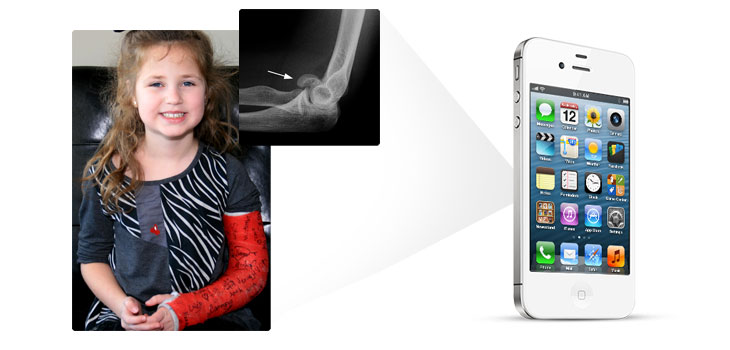
What to do when a little tyke shows up in the Emergency Room at 7pm with an elbow fracture? Now there is clarity, as the American Academy of Orthopaedic Surgeons (AAOS) has just released new Appropriate Use Criteria (AUC) and a mobile app for the treatment of pediatric supracondylar humerus fractures.
AAOS: New Criteria, App for Pediatric Elbow Fractures
2 min read Premium comments
Secondary
“These are very serious injuries requiring appropriate evaluation and treatment, ” said James Sanders, M.D., in the September 9, 2014 news release. Dr. Sanders is chair of the AAOS AUC for the Management of Pediatric Supracondylar Humerus Fractures work group. “These criteria will be helpful for clinicians who treat these injuries on an occasional basis.”
With these new criteria, surgeons have several algorithms for treating an orthopedic injury or condition. According to the news release, there are even “hypothetical scenarios and possible treatments, ranked for appropriateness based on the latest research and clinical expertise and experience. Optimal treatment may require the surgical placement of a pin to hold the realigned bones, while protecting the surrounding nerves and blood vessels, or nonsurgical treatment with a cast or splint. When not treated correctly, these injuries can result in deformity, limited range of motion and the need for additional surgery.”
As noted in the news release, the related app comes with three sections, the first being a list of assumptions/or considerations for treatment:
- “The patient is healthy enough to undergo surgery, if needed.
- A thorough history and physical examination of the patient has been conducted.
- Adequate radiographs (imaging) have been obtained and examined.
- The surgeon who cares for the child can perform the appropriate orthopaedic procedures.
- The surgery will be performed in a timely fashion, in an appropriate location.
- The facility has proper implants, ancillary equipment, and capable support personnel.”
“It helps them to ask, ‘should we be treating this child, or should the child be transferred to another hospital?’” said Dr. Sanders.
Having agreed that the above assumptions are met, the treating physician is presented with nearly 3, 200 possible patient injury scenarios. Then the surgeon selects the correct scenario and proceeds to receive the related treatments ranked for their appropriateness, “helping to ensure optimal care and the best long-term outcome for resuming functional use of the elbow, ” said Dr. Sanders.
Dr. Sanders told OTW, “Developing criteria for the patient who has an associated vascular injury were the most challenging, and we are continuing to develop those criteria.”
As for how long it may take surgeons to begin using the criteria, Dr. Sanders noted, “It will probably not be very long for them to be used since most surgeons will find them very logical.”
React:
Discussion
This is a fascinating development. In my practice we've seen similar outcomes with the revised protocol. The key differentiator seems to be patient selection criteria. Has anyone else noticed the correlation with BMI thresholds?
Great point. I'd push back slightly on the conclusion, the sample size in the cited study is too small to draw population-level inferences. That said, the directional signal is compelling and worth a larger RCT.
We implemented a similar approach last year. Early results are promising but we're still gathering 12-month follow-up data. Happy to share our protocol if anyone is interested.
Join the conversation
Orthopedic professionals are discussing this. Sign in and upgrade to read every comment and add your voice.