
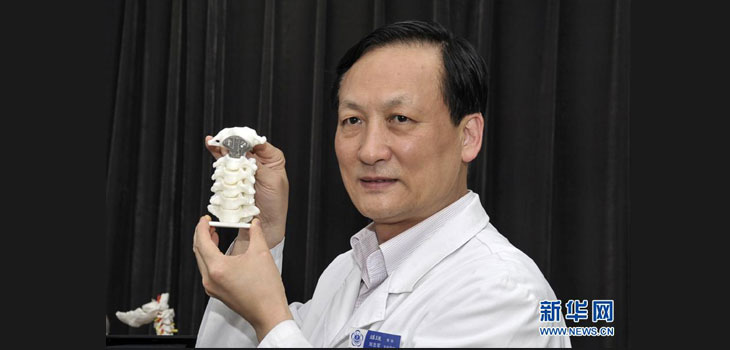
The Chinese are forging ahead with 3-D printed implants. Forbes Magazine and Emily Wasserman, writing for Fierce Medical Devices, both report that doctors at Beijing’s Peking University replaced a cancerous vertebra in a 12-year-old boy’s spinal cord with a 3-D piece that they created from titanium powder. The implant was made with small pores which they believe will allow bone tissue to grow into the device. This eliminated the need for cement or screws, explained Liu Zhonguin, the head of the Orthopaedics Department at Peking University.
3-D Implants Tested Worldwide
1 min read Premium comments
Secondary
Not to be left behind, Wassermann noted that in May 2013 doctors at the University of Michigan had created and implanted a 3-D printed tracheal splint in a infant. They created a model of the device by taking a CAT scan of the baby’s respiratory track and then printed the implant from bio absorbable plastic.
And in the UK an orthopedic surgeon created a replacement hip from titanium powder using the hospital’s 3-D printer and implanted it in an elderly cancer patient. According to a report from Freedonia cited by Forbes and Wasserman, the demand for implantable medical devices in the U.S. is expected to increase 7.7% annually to $52 billion in 2015.
Author
React:
Discussion
This is a fascinating development. In my practice we've seen similar outcomes with the revised protocol. The key differentiator seems to be patient selection criteria. Has anyone else noticed the correlation with BMI thresholds?
Great point. I'd push back slightly on the conclusion, the sample size in the cited study is too small to draw population-level inferences. That said, the directional signal is compelling and worth a larger RCT.
We implemented a similar approach last year. Early results are promising but we're still gathering 12-month follow-up data. Happy to share our protocol if anyone is interested.
Join the conversation
Orthopedic professionals are discussing this. Sign in and upgrade to read every comment and add your voice.