
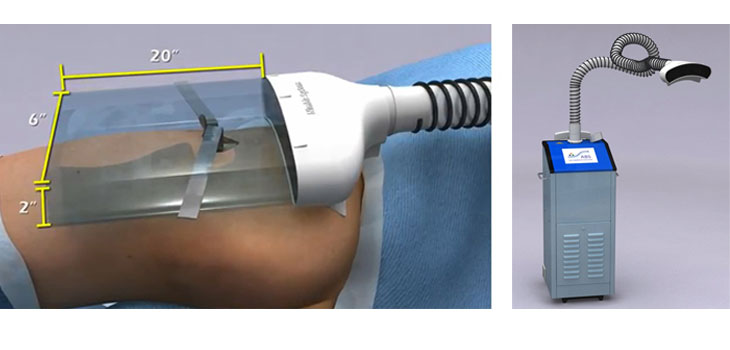
Question: What is portable, inexpensive, and fights infection? The Air Barrier System (ABS), an FDA-cleared device that shields surgical sites from bacteria in the OR. And now, Nimbic Systems, creator of the device, has received a $1.5 million National Institutes of Health (NIH) grant for a pivotal, multi-center clinical trial.
$1.5 Million to Study Anti-Infection Device
1 min read Premium comments
Secondary
According to the September 15, 2014 news release, the ABS works by “creating a localized clean-air field over the surgery site that prevents airborne microorganisms from entering the incision. Currently, the ABS is cleared for use in hip arthroplasty and posterior spine surgery. In a clinical study funded by an SBIR Phase I grant from National Sciences Foundation and published in the August 2011 issue of Journal of Arthoplasty, the ABS reduced the presence of airborne bacteria at incision sites during hip surgery by up to 84%.”
Additionally, in April 2015 the company plans to publish the results of its current NIH-sponsored Phase II clinical trial of the ABS. “This Phase II study is a prospective randomized clinical trial that examines the ability of the ABS device to reduce the clinical rate of prostheses-related infection in 300 patients undergoing hip, spine, and certain vascular implant procedures.”
Sean Self, president of Nimbic Systems, told OTW, “We are fortunate to have formed a partnership with infection prevention thought leaders at Baylor College of Medicine and the University of Texas Medical Branch at Galveston. Multi-center clinical trials require a great amount of communication and leadership in order to obtain valuable data. Our first steps will be to host educational meetings with all of the investigators, nurses, technicians, and other staff to explain the importance of our research and what the essential responsibilities are.”
As for where they hope to be six months from now, Self noted, “By April 2015 we expect to have 100 patients enrolled in this multi-center study. The study will enroll 800 patients in total over a two-year period followed by a one-year follow up period to monitor patients for incidences of surgical site infection.”
React:
Discussion
This is a fascinating development. In my practice we've seen similar outcomes with the revised protocol. The key differentiator seems to be patient selection criteria. Has anyone else noticed the correlation with BMI thresholds?
Great point. I'd push back slightly on the conclusion, the sample size in the cited study is too small to draw population-level inferences. That said, the directional signal is compelling and worth a larger RCT.
We implemented a similar approach last year. Early results are promising but we're still gathering 12-month follow-up data. Happy to share our protocol if anyone is interested.
Join the conversation
Orthopedic professionals are discussing this. Sign in and upgrade to read every comment and add your voice.