
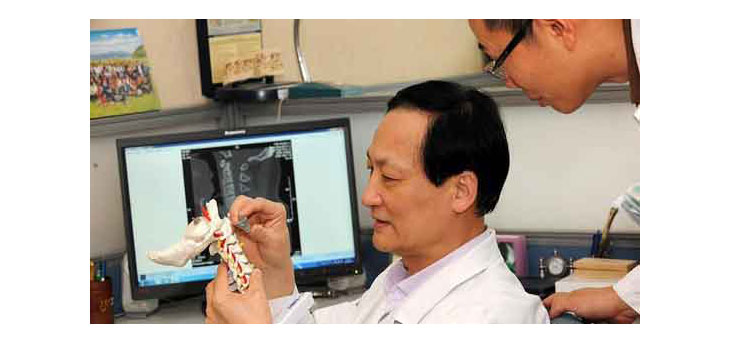
Chinese spine surgeons have performed the world’s first 3D printed vertebra surgery.
World’s First 3D Printed Vertebra Surgery
2 min read Premium comments
Secondary
According to an August 8, 2014 report on CCTV.com, surgeons at No. 3 Hospital, Peking University, replaced the second vertebra in a 12-year-old boy’s neck after developing cancer in the bone. The boy had been lying in the orthopedics ward for more than two month and could only stand up occasionally for a few minutes.
Vertebra #2
The five-hour surgery involved the spinal cord, the internal and external carotid arteries and the trachea. Only five hospitals in China could perform the operation. Once the vertebra was removed, an implant needed to be placed between the first and third vertebrae to allow the boy to raise his head after surgery.
“With 3D printing technology, we can simulate the shape of the vertebra, which is much stronger and more convenient than traditional methods, ” said Liu Zhongjun, M.D., director of orthopedics at the hospital. “This is the first use of a 3D printed vertebra as an implant for orthopedic spine surgery in the world, ” Liu said.
Oxford Performance Materials Printer
The printer used by the hospital is made by Connecticut-based Oxford Performance Materials, Inc. (OPM), an advanced materials and additive manufacturing (3D printing) company.
On August 14, 2014, the company announced it had received The New Economy Award for the company’s development of additive manufacturing techniques with the ultra-high performance polymer poly-ether-ketone-ketone (PEKK). “OPM’s ability to print patient-specific functional and biocompatible prosthetic implants is proving to be disruptive technology in the healthcare industry, ” said the company. In February 2013, OPM received FDA 510(k) clearance for its OsteoFab Patient-Specific Cranial Device, and became the first and only company with FDA clearance to manufacture 3D printed polymeric orthopedic implants.
Scott DeFelice, CEO and Chairman of OPM said the rising cost of healthcare is a global issue that cannot be ignored. “Hospitals are adopting our OsteoFab implant lines over metals and other polymer options because 3D printed PEKK implants are the only solutions that combine low cost, biocompatibility, radiolucency, and bone-like behavior. For the surgeon, OPM products are easier to implant, modify and observe, and studies have shown that our formulation is osteoconductive and this leads to better fixation to the patient’s own bone.”
Recovery Expected
Five days after the operation, the boy still could not speak and had to use a writing board to communicate. But doctors say he is in a good physical condition and will recover soon.
To watch the CCTV report, click here.
Author
React:
Discussion
This is a fascinating development. In my practice we've seen similar outcomes with the revised protocol. The key differentiator seems to be patient selection criteria. Has anyone else noticed the correlation with BMI thresholds?
Great point. I'd push back slightly on the conclusion, the sample size in the cited study is too small to draw population-level inferences. That said, the directional signal is compelling and worth a larger RCT.
We implemented a similar approach last year. Early results are promising but we're still gathering 12-month follow-up data. Happy to share our protocol if anyone is interested.
Join the conversation
Orthopedic professionals are discussing this. Sign in and upgrade to read every comment and add your voice.