
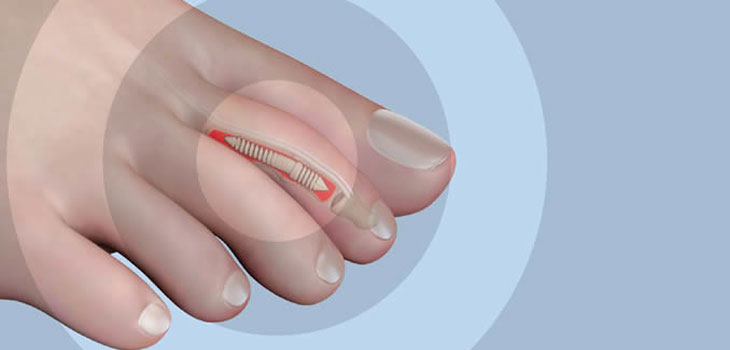
Toes in distress now have an option available from Smith & Nephew, plc. The company has entered the forefoot market with the launch of the HAT-TRICK Lesser Toe Repair System. The system has products for metatarsophalangeal (MTP) ligament repair and reconstruction, a metatarsal osteotomy guide, and a revisable, all-PEEK implant for Proximal Inter-Phalangeal (PIP) fusion, also known as hammer toe correction.
S&N Enters Forefoot Market With HAT-TRICK
2 min read Premium comments
Secondary
As indicated in the news release, with the new HAT-TRICK System, surgeons have access to the HAT-TRICK MTP Joint Repair System, which provides a complete repair of the lesser MTP joint that is less invasive and more anatomic than current standard of care techniques. The HAT-TRICK Osteotomy Guide, which allows for a controlled, precise and reproducible approach that maintains the biomechanical axis of the metatarsal, and the HAT-TRICK PIP Fusion System, which is an all-inside fusion of the PIP joint that is less invasive than other standard of care options.”
“We are excited to expand our successful foot and ankle portfolio into the forefoot, ” said Mark Waugh, vice president, Extremities and Limb Restoration for Smith & Nephew, in the July 31, 2014 news release. “In addition to being a high-growth area, we believe there are tremendous opportunities for us to enhance the surgeon experience, simplify the procedures and, most importantly, improve patient outcomes.”
“Although treating lesser toe deformities is extremely common, getting consistently predictable outcomes has eluded surgeons worldwide, ” explained orthopedic surgeon Charles Saltzman, M.D., chairman of the system’s scientific advisory board. “Current standards of treatment are known to have unacceptably high complication rates.”
Waugh told OTW, “The HAT-TRICK System puts us in the right place at the right time. We’re introducing a suite of solutions, including a surgeon-friendly PIP fusion device, and a procedure that addresses the underlying problem that leads to hammer toe deformity. The surgeons involved in the design of the product are keenly interested in bringing down the high complication rates in this segment of the fast-growing extremities market.”
“In development, Smith & Nephew’s LifeModeler system was used to compare the HAT-TRICK System’s method of MTP joint repair to a Weil osteotomy repair, a flexor tendon transfer repair, and a normal MTP joint. Using a state of the art cadaver-validated computer model, the design team captured kinematic data on centers of rotation, dorsal drawer stability and dorsiflexion stiffness. HAT-TRICK Bilateral Joint Repair showed no notable change versus the normal MTP joint for any of the kinematic metrics. In the same study, a Weil osteotomy showed decreased stability, decreased stiffness and shifted centers of rotation, while flexor tendon transfer showed increased stability, increased stiffness and shifted centers of rotation.”
Author
React:
Discussion
This is a fascinating development. In my practice we've seen similar outcomes with the revised protocol. The key differentiator seems to be patient selection criteria. Has anyone else noticed the correlation with BMI thresholds?
Great point. I'd push back slightly on the conclusion, the sample size in the cited study is too small to draw population-level inferences. That said, the directional signal is compelling and worth a larger RCT.
We implemented a similar approach last year. Early results are promising but we're still gathering 12-month follow-up data. Happy to share our protocol if anyone is interested.
Join the conversation
Orthopedic professionals are discussing this. Sign in and upgrade to read every comment and add your voice.