
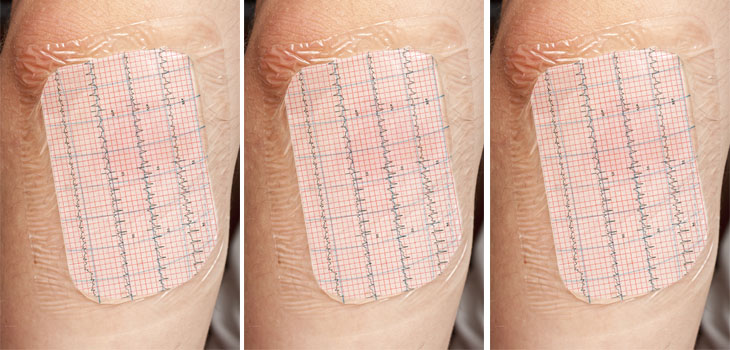
It was bound to come—a smart bandage that could monitor whatever was happening to the patient beneath it. A group of scientists at the National Taiwan University in Taipei have developed Bioscope. Bioscope is a bandage that tracks a hospital patient’s vital signs—temperature, heartbeat, movement—and wirelessly transmits the information to a computer. Sensor modules are 3D printed onto the bandage, so that the nursing staff, depending on each patient’s needs, can switch them around.
Smart Bandage Monitors Vital Signs
1 min read Premium comments
Secondary
Emily Wasserman, of Fierce Medical Devices, writes that the system “includes a heart rate monitor that measures electrical activity at the skin surface, a contact thermometer that measures temperature, an accelerometer that monitors physical movement and a contact microphone that picks up on sound patterns from internal organs.”
Scientists envision that eventually the device could allow physicians to make diagnoses remotely and monitor patients once they’ve left the hospital.
The Taiwan researchers are not alone in their quest for smart bandages and devices that can remotely monitor a patient’s condition. Wasserman reports that earlier this year the FDA cleared the first contact-free sensor to monitor heart and respiratory rates in a chair. EarlySense’s chair, called Sensor Solution, is placed underneath a chair cushion and tracks a patient’s health without any attachment leads or cuffs. It is apparent that patient monitoring technology is becoming a growing niche in the healthcare industry.
Author
React:
Discussion
This is a fascinating development. In my practice we've seen similar outcomes with the revised protocol. The key differentiator seems to be patient selection criteria. Has anyone else noticed the correlation with BMI thresholds?
Great point. I'd push back slightly on the conclusion, the sample size in the cited study is too small to draw population-level inferences. That said, the directional signal is compelling and worth a larger RCT.
We implemented a similar approach last year. Early results are promising but we're still gathering 12-month follow-up data. Happy to share our protocol if anyone is interested.
Join the conversation
Orthopedic professionals are discussing this. Sign in and upgrade to read every comment and add your voice.