
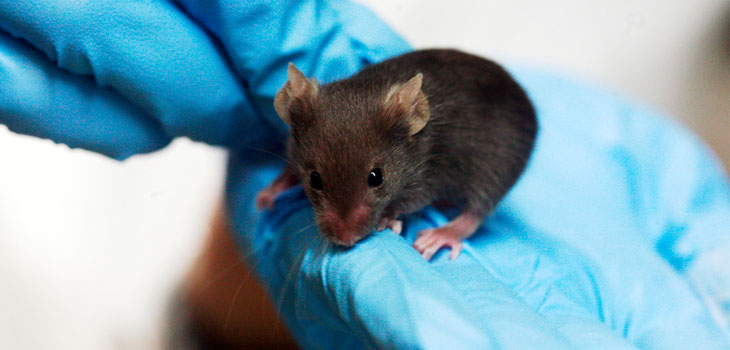
Swiss researchers at ETH Zurich say that they have treated and cured mice with rheumatoid arthritis (RA). The team indicates that they have developed a drug that is a biotechnologically produced active substance consisting of two fused components. The first one is interleukin 4 (IL-4); then, the ETH scientists “coupled an antibody to IL-4 that, based on the key-lock principle, binds to a form of a protein that is found only in inflamed tissue in certain diseases (and in tumor tissue).”
RA Cured in Mice!
1 min read Premium comments
Secondary
“As a result of combination with the antibody, IL-4 reaches the site of the disease when the fusion molecule is injected into the body, ” says pharmacist Teresa Hemmerle in the August 6, 2014 news release. Hemmerle has just completed her dissertation in the group of Dario Neri, a professor at the Institute of Pharmaceutical Sciences. Together with Fabia Doll, also a Ph.D. pharmacist at ETH, she is the lead author of the study. “It allows us to concentrate the active substance at the site of the disease. The concentration in the rest of the body is minimal, which reduces side-effects, ” she says.
The researchers found that the mice developed swollen, inflamed toes and paws within a few days. Part of the scientists’ work involved examining “the fusion molecule in combination with dexamethasone, a cortisone-like anti-inflammatory drug that is already used to treat rheumatoid arthritis in humans. The researchers started treating each mouse as soon as they began showing signs of the disease in the form of swollen extremities.”
Administered separately, each medication only managed to slow the progression of the disease in the affected animals. Taken together, however, the drugs resulted in a total halting of the above mentioned symptoms. The team indicated that concentrations of immune messengers in blood and inflamed tissue, which are changed in rheumatoid arthritis, returned to their normal levels. “In our mouse model, this combined treatment creates a long-term cure, ” says Hemmerle, who, since completing her dissertation, has been working at Philochem, where she continues the project.
Philochem will now move forward with clinical trials on people suffering from rheumatoid arthritis.
Author
React:
Discussion
This is a fascinating development. In my practice we've seen similar outcomes with the revised protocol. The key differentiator seems to be patient selection criteria. Has anyone else noticed the correlation with BMI thresholds?
Great point. I'd push back slightly on the conclusion, the sample size in the cited study is too small to draw population-level inferences. That said, the directional signal is compelling and worth a larger RCT.
We implemented a similar approach last year. Early results are promising but we're still gathering 12-month follow-up data. Happy to share our protocol if anyone is interested.
Join the conversation
Orthopedic professionals are discussing this. Sign in and upgrade to read every comment and add your voice.