
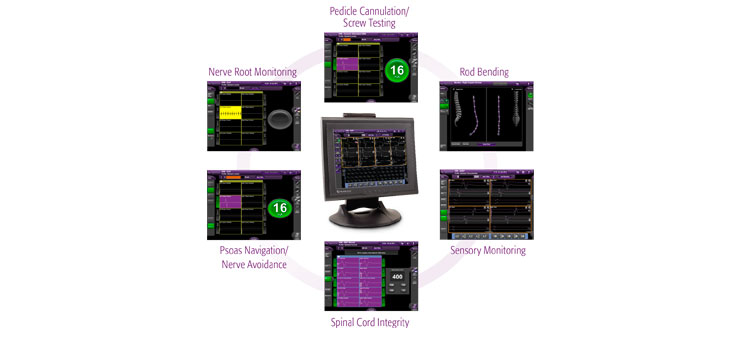
NuVasive, Inc. is announcing NVM5 V2.0, a new nerve monitoring technology designed to further reproducible outcomes in spine surgery. The company believes that the procedural integration of neurophysiology and computer-assisted surgical technologies facilitates these reproducible outcomes.
NuVasive Announces Nerve Monitoring Technology
1 min read Premium comments
Secondary
This second generation technology has new capabilities that include the sensory monitoring modality, somatosensory evoked potentials (SSEPs) for multimodality monitoring of the spinal cord and peripheral nerves, as well as refinements to the recently launched spinal rod bending technology called Bendini.

" data-large-file="https://i0.wp.com/ryortho.com/wp-content/uploads/2014/08/NuVasive_NVM5NerveMonitoringTechnology_WEB2.jpg?fit=730%2C730&ssl=1" src="https://i0.wp.com/ryortho.com/wp-content/uploads/2014/08/NuVasive_NVM5NerveMonitoringTechnology_WEB2.jpg?resize=730%2C730&ssl=1" alt="NVM5 Nerve Monitoring Technology / Source: NuVasive, Inc." width="730" height="730">NVM5 Nerve Monitoring Technology / Source: NuVasive, Inc.
As indicated by Nuvasive, the device provides information directly to the surgeon, to help assess a patient’s neurophysiologic status. NVM5 provides this information by electrically stimulating nerves via electrodes located on surgical accessories and monitoring electromyography (EMG), transcranial motor evoked potential (TcMEP), or SSEP responses of nerves. The system also integrates Bendini software used to locate spinal implant instrumentation for the placement of spinal rods. All technologies are designed to seamlessly integrate into NuVasive procedural solutions designed to help increase surgical efficiency and reproducibility.
Pat Miles, president, Global Products & Services, told OTW, “NVM5 V2.0 leverages the experience that NuVasive has accumulated through the past 12 years, with more than 250, 000 spine surgeries utilizing this proprietary monitoring platform.”
React:
Discussion
This is a fascinating development. In my practice we've seen similar outcomes with the revised protocol. The key differentiator seems to be patient selection criteria. Has anyone else noticed the correlation with BMI thresholds?
Great point. I'd push back slightly on the conclusion, the sample size in the cited study is too small to draw population-level inferences. That said, the directional signal is compelling and worth a larger RCT.
We implemented a similar approach last year. Early results are promising but we're still gathering 12-month follow-up data. Happy to share our protocol if anyone is interested.
Join the conversation
Orthopedic professionals are discussing this. Sign in and upgrade to read every comment and add your voice.