
Blowing autograft out of the water? Perhaps. Researchers from Texas A&M University are reporting that they have developed a new material that expands with warm salt water and “precisely” fill bone defects. The material—a shape-memory polymer (SMP)—is also a scaffold for new bone growth.
New Shape-Memory Polymer Molds to Shape of Bone Defect
2 min read Premium comments
Secondary
“The problem is that the autograft is a rigid material that is very difficult to shape into these irregular defects, ” said Melissa Grunlan, Ph.D., leader of the study, in the August 13, 2014 news release. Also, harvesting bone for the autograft can itself create complications at the place where the bone was taken.
The team notes that surgeons may also use bone putty or cement as an option, but that both of these “become very brittle when they harden, and they lack pores, or small holes, that would allow new bone cells to move in and rebuild the damaged tissue.”
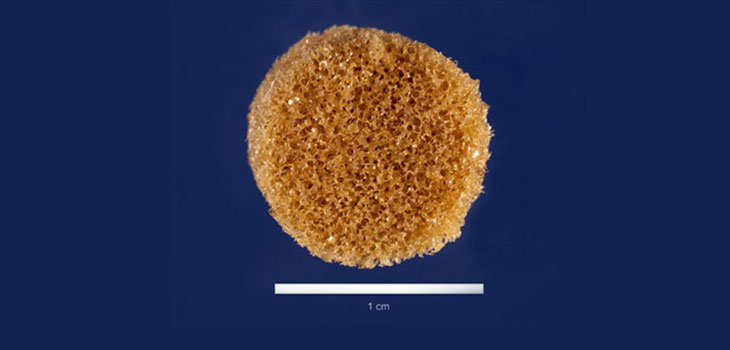
As noted in the news release, the researchers “made a porous SMP foam by linking together molecules of poly(ε-caprolactone), an elastic, biodegradable substance that is already used in some medical implants. The resulting material resembled a stiff sponge, with many interconnected pores to allow bone cells to migrate in and grow. Upon heating to 140 degrees Fahrenheit, the SMP becomes very soft and malleable. So, during surgery to repair a bone defect, a surgeon could warm the SMP to that temperature and fill in the defect with the softened material. Then, as the SMP is cooled to body temperature (98.6 degrees Fahrenheit), it would resume its former stiff texture and ‘lock’ into place.”
The SMP, which is biodegradable, was coated with a sticky substance known as polydopamine, which helps lock the polymer into place. The hope is that it will help osteoblasts adhere and spread throughout the polymer. In order to test the SMP’s efficacy regarding bone cell growth, the researchers added human osteoblasts to the polymer. According to the news release, “After three days, the polydopamine-coated SMPs had grown about five times more osteoblasts than those without a coating. Furthermore, the osteoblasts produced more of the two proteins, runX2 and osteopontin, that are critical for new bone formation.”
Dr. Grunlan told OTW, “Currently, we are targeting using this self-fitting foam to treat cranio-maxillofacial bone defects such as those that occur due to tumor removal, injury or birth defects. While autografting remains the ‘gold standard’ for treatment for these defects, associate complications has prompted us to develop this new material.”
“We would like to move into pre-clinical and clinical tests to understand the bone healing capacity of this material. To do so, we will need to partner with the right clinicians and sponsors.”
React:
Discussion
This is a fascinating development. In my practice we've seen similar outcomes with the revised protocol. The key differentiator seems to be patient selection criteria. Has anyone else noticed the correlation with BMI thresholds?
Great point. I'd push back slightly on the conclusion, the sample size in the cited study is too small to draw population-level inferences. That said, the directional signal is compelling and worth a larger RCT.
We implemented a similar approach last year. Early results are promising but we're still gathering 12-month follow-up data. Happy to share our protocol if anyone is interested.
Join the conversation
Orthopedic professionals are discussing this. Sign in and upgrade to read every comment and add your voice.