
The young salesman sat in the audience in Philadelphia, listening to the controversial physician describes his crazy ideas for a new surgical procedure.
In Defense of Sales and Sales People
8 min read Premium comments
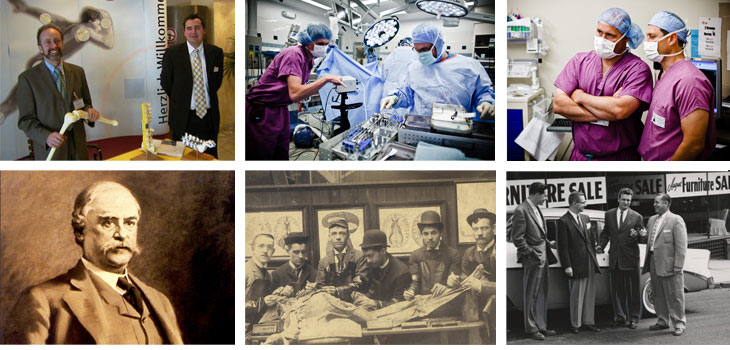
This physician’s ideas were not just new, they were laughable. The Dr. Famouses in his audience could barely conceal their contempt. Even worse, this particular physician couldn’t help digging himself into a rhetorical hole. The young man watching this increasingly depressing spectacle could only wonder at what was being lost. Today, we know what might have been lost. And it boggles the mind.
Character Counts

The great historian David McCullough said, “There is nothing inevitable about history. There is only the character of the actors making the best decisions they can at the time.”
That young man sitting among an increasingly skeptical, even hostile audience was convinced that the physician at the podium was right. That young man’s name was Robert Wood Johnson and that mush-mouthed physician hectoring his colleagues was Joseph Lister, M.D. The place was the 1876 Centennial Exposition in Philadelphia.
Robert Wood Johnson, like great visionaries before and after him, could somehow organize Lister’s information in a way that would break through objections and bring to the operating room a new, unfamiliar yet absolutely revolutionary technology.
With his brothers, Robert Wood Johnson would found the largest medical technology company ever in the history of man on the shoulders of Lister’s technology. Johnson & Johnson.
Great Ideas, Great Execution
Mark Twain’s famous quote, “The reports of my death have been greatly exaggerated, ” could also be applied to the modern orthopedic medical device salesperson. But as Dr. Lister and Robert Wood Johnson showed, great medicine must always be combined with great sales ability to bring the science to patients.
As stories about “Rep-Less” medical device sales grow, it might be worth remembering that a great idea without the ability to promote and execute the idea means patients won’t see the benefits.
Lister’s Vision

Lister had come to Philadelphia that summer to convince Americans of the evidence of antiseptic surgery. He said more patients survived surgery when the knife, instruments, supplies and clothing were sterilized. Surgery was unsanitary, most doctors didn’t yet believe in the germ theory of disease involving things they couldn’t see and many came to Philadelphia to trash Lister’s ideas. In fact, according to historical archives from the Kilmer House, Lister was invited to speak by some very prominent American surgeons who were determined to discredit his arguments for sterile surgery.
If a surgeon wanted to try sterile surgery in the late 1800’s, he had to make his own sterile dressings and sterilize everything himself unless he was in a large hospital. Surgeons used dressings that were made from scraps from the floors of cotton mills, and when they needed to close a wound or incision, they frequently pulled their trusty sewing needle and sewing thread out of the lapel of their seldom-cleaned frock coat, re-using that same germ-filled needle and thread on patient after patient. Surgical survival rates before sterile surgery were low.
It was “ungentlemanly” to wash hands. Civil War surgeons went from wound to wound without cleaning up and wore the stains of surgery proudly on their aprons and hands.
In 1867, The Lancet reported on a new system of antisepsis using carbolic acid (phenol) which had been devised by a young Joseph Lister.
While a professor of surgery at the University of Glasgow, Lister read the papers of Louis Pasteur, who showed that rotting and fermentation of food could occur under anaerobic conditions if micro-organisms were present. Pasteur believed getting rid of the micro-organisms could prevent gangrene.
Lister decided to develop “antiseptic” techniques for wounds and used Friedlieb Ferdinand Runge’s 1834 discovery of carbolic acid derived from coal tar. He tested the substance and it worked.
Skeptics Abound
However, like anesthesia, antisepsis was initially met with “overwhelming skepticism, ” and as the New England Journal of Medicine mentioned at the time, such procedures were neither original nor beneficial.
Not until the end of the 1800s did the Journal even mention favorably the concept of antisepsis and it did so by describing an 1847 observation by Viennese obstetrician, Ignaz Semmelweiss that hand washing by birth attendants eliminated puerperal sepsis.
Johnson’s Sweat
But in 1876, Johnson listened and began developing sterile surgical dressings and sutures. He worked 12 hours a day to get his aseptic surgery equipment to customers. By 1878, he and his partner George Seabury were making $10, 000 per month ($214, 000 in 2006 dollars). But Johnson and his partner couldn’t agree on how to invest the profits or the involvement of Robert’s brother, James in the firm. In 1880 they split up, and as they say, the rest is history.
Marketing Genius
Johnson’s path crossed with another great historical character which further gave birth to the role of the modern medical device salesperson. That person was J. Walter Thompson, the legendary father of modern advertising.
Johnson had a desk job in a medical product brokerage. Thompson was a bookkeeper in an ad agency that was doing so badly, he later bought it for $500. Years later, Johnson tapped Thompson to develop breakthrough ads of Johnson & Johnson’s game-changing health care products. In 1886 the J. Walter Thompson agency handled media for J&J’s first consumer product, a toothpaste called Zonweiss.
Robert Wood Johnson
Robert Wood Johnson was born in 1845 in Carbondale, Pennsylvania, and grew up with two older brothers, James and Edward.
When his brothers went off to fight the Civil War, Robert’s parents sent him to apprentice in Poughkeepsie, New York, with his uncle, James Wood, to work for the apothecary of Wood & Tittmer. There, he learned how to prepare medicinal plasters. He saw himself as being in a healing profession.
Margaret Gurowitz, chief historian of Johnson & Johnson told Investor Business Daily that Robert was a very outgoing and inquisitive person. Those traits led him to seek bigger opportunities and in 1864 at age 19 he left Poughkeepsie to work in New York City for Roushton & Aspinwall, a medical sales brokerage.
He sold drug and medical products for a decade before forming the partnership with George Seabury.
Plaster to Aseptic Products
The pair started out making plasters in an India rubber combination. Ian Ellis of the Today in Science History website wrote, “Many older druggists tell how they saw him from day to day in an old loft, bare-armed and clothed in jumpers, struggling with whitewash brush and a pail of mush spreading the first ‘Benzine’ plasters. He succeeded in producing all the plasters of the (standard medical formula) with a rubber base, with the effect of relegating all other forms out of use and creating a new era in plaster-making and uses.”
Then Johnson met Lister and remembered his brothers’ stories of brutal wounds and field surgeries in the war.
Johnson wanted to focus on mass-producing aseptic surgery gauze and dressings, but Seabury wanted to expand the company’s plaster business. In 1875, Seabury brought his brother into the firm. Johnson hired his own two brothers. By 1884 there were too many disagreements and too many brothers and the firm split up.
J&J Is Born

Robert’s brothers, James and Edward left and set up their own medical products business, J&J in New Brunswick, New Jersey, and hired their first 14 employees from the old Seabury & Johnson.
However, the brother struggled and didn’t have enough capital for a startup company. While the two brothers were going at it alone, Seabury was unable to pay Johnson the monthly payments that had been agreed upon when he left the partnership. Seabury agreed to let Johnson re-enter the medical industry if he didn’t have to pay the monthly payments anymore. Johnson agreed, and joined his brothers’ firm in 1886, providing the capital for a fresh start to mass-produce America’s first surgical dressings.
Serve the Customer
Johnson went everywhere to find out what his drugstore customers needed.
On one of those market research trips, he met Fred Kilmer, a pharmacy owner in New Brunswick. Kilmer became J&J’s scientific officer and chief publicity officer in 1889.
Kilmer was another born promoter and began efforts to generate demand among surgeons for sterile products. Since many of them lacked the resources and technical knowledge to try antiseptic surgery, the pair developed a how-to manual. In 1888 they published “Modern Methods of Antiseptic Wound Treatment” and gave it away free to medical professionals. Kilmer wrote the parts of the book that deal with the case for sterile technique — leading to a higher patient survival rate—and general practice principles. It also includes surgical case studies from leading antiseptic surgeons.
Free stuff for surgeons to stimulate demand for the products. The Department of Justice wasn’t prosecuting surgeons yet.
The pair also developed the first aid kits for railroads so their surgeons could treat injured construction workers and engineers. They developed that kit with the assistance of the railroad surgeons.
From Start-Up to Giant
The new partnership gave Johnson half of the company’s shares in return for management of the company. His brothers would receive thirty percent of the company. Johnson worked all hours of the day going back and forth from the factory in New Brunswick to the office in New York, and by early 1888, J&J was making $25, 000 a month.
From a startup firm with 14 employees occupying one floor of a factory building in 1886, Johnson & Johnson grew into an operation of several thousand workers in what was the largest factory space in the world when Johnson died at age 64.
Today, J&J produces an array of health care products ranging from prescription drugs and surgical devices to Band-Aids.
J&J went public in 1944. According to the company, an investor buying $375 worth of shares back then would have J&J stock worth more than $10 million now. Since 1970 alone, the stock has rocketed 10, 000%.
Go Forth and Innovate
George Seabury decided to stick with the tried and true. Robert Wood Johnson did what great salespeople have always done; figure out what his customers didn’t realize they needed yet.
Healthcare is still in its infancy. There is a salesperson out there figuring out what surgeons need next. And they’ll succeed.
Author
React:
Discussion
This is a fascinating development. In my practice we've seen similar outcomes with the revised protocol. The key differentiator seems to be patient selection criteria. Has anyone else noticed the correlation with BMI thresholds?
Great point. I'd push back slightly on the conclusion, the sample size in the cited study is too small to draw population-level inferences. That said, the directional signal is compelling and worth a larger RCT.
We implemented a similar approach last year. Early results are promising but we're still gathering 12-month follow-up data. Happy to share our protocol if anyone is interested.
Join the conversation
Orthopedic professionals are discussing this. Sign in and upgrade to read every comment and add your voice.