
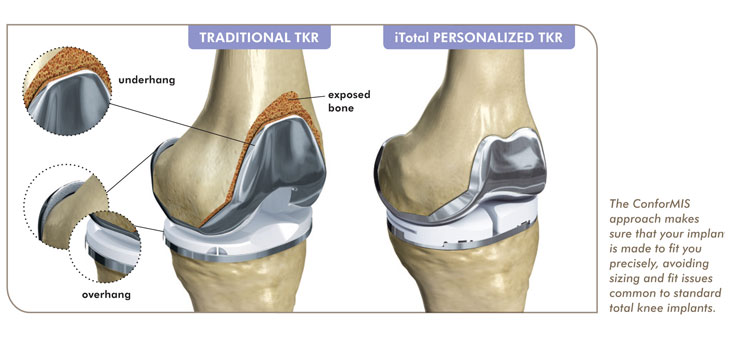
ConforMIS, Inc.’s iTotal faces off against its off-the-shelf (OTS) competitors…In two in vivo clinical studies comparing these adversaries, researchers found that the motion and stability of ConforMIS’ iTotal behaved much more like a normal knee. Additionally, these studies debuted the use of a novel fluoroscopy system developed by Dr. William Hamel and Dr. Richard Komistek. This real-time mobile X-ray captures a wider array of normal movements, by, for example, following a patient as he or she walks.
ConforMIS’ iTotal Trumps Off-the-Shelf Competitors
2 min read Premium comments
Secondary
In one study, William Kurtz, M.D. evaluated patients treated with a ConforMIS customized implant versus patients treated with an off-the-shelf implant. As stated in the August 6, 2014 news release, one result was that “91% of patients with a ConforMIS customized knee experienced a motion pattern and rotation consistent with the normal knee, compared to only 56% of patients with an off-the-shelf implant.”
In another study, Harold Cates, M.D. evaluated kinematics of patients with a ConforMIS customized implant versus another off-the-shelf implant while they performed basic movements. One result was that “all ConforMIS subjects experienced posterior femoral rollback of their lateral condyle, consistent with the motion of a normal knee, compared with only 50% of traditional, off-the-shelf subjects.”
Dr. Kurtz told OTW, “I was not surprised to find that my ConforMIS knees moved like a normal knee whereas my off-the-shelf knees moved like previously reported CR TKAs [total knee arthroplasty]. The ConforMIS knee is a true resurfacing knee replacement that puts everything right back where it came from so I expected normal motion. I was surprised, however, that the mid-flexion paradoxical motion seen in the OTS knees was the ultimate cause of the decreased max-flexion. I always thought the problems with mid-flexion instability corrected once you got out of mid-flexion, but it turns out that the loss of axial motion (or lateral rollback) that occurred in mid-flexion with the OTS knees was not recoverable as the knee continued into deep flexion and lead to considerably less flexion in the OTS group.”
“We anticipated that we would find a difference in the range of motion achieved after TKA between the customized implant and the traditional off-the-shelf because the ConforMIS implant matches each patient’s knee size and shape. In addition to improved range of motion with the ConforMIS patients, what we found was that none of the ConforMIS patients had abnormal lift off of the implant of either the medial or lateral portion of the knee compared to 56% of off-the-shelf patients. Given that abnormal lift off is an indicator of instability of the knee, the results demonstrate that the ConforMIS implant can offer patients stability like that of a normal knee.”
“When my patients come in for a TKA they are looking for an implant that will behave like their normal knee. They want to regain stability and range of motion so that they can return to their everyday activities as quickly as possible. These results show that the ConforMIS customized knee outperforms traditional, off-the-shelf implants in delivering these benefits.”
Author
React:
Discussion
This is a fascinating development. In my practice we've seen similar outcomes with the revised protocol. The key differentiator seems to be patient selection criteria. Has anyone else noticed the correlation with BMI thresholds?
Great point. I'd push back slightly on the conclusion, the sample size in the cited study is too small to draw population-level inferences. That said, the directional signal is compelling and worth a larger RCT.
We implemented a similar approach last year. Early results are promising but we're still gathering 12-month follow-up data. Happy to share our protocol if anyone is interested.
Join the conversation
Orthopedic professionals are discussing this. Sign in and upgrade to read every comment and add your voice.