
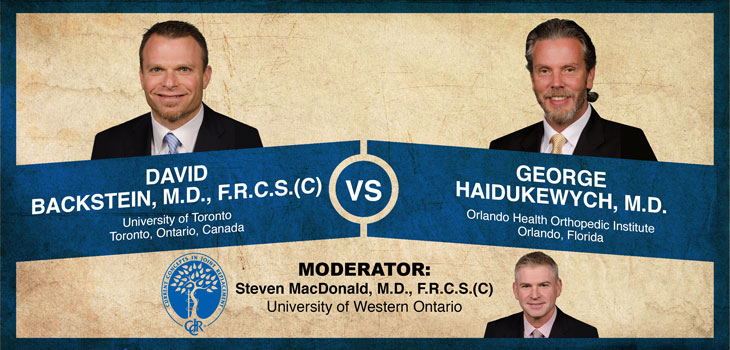
This week’s Orthopaedic Crossfire® debate is “Mega Prostheses for Well Fixed TKA Femoral Fx’s.” For the proposition is David Backstein, M.D., F.R.C.S.(C) of the University of Toronto. Against the proposition is George Haidukewych, M.D. of Orlando Health Orthopedic Institute. Moderating is Steven MacDonald, M.D., F.R.C.S.(C) of the University of Western Ontario.
Backstein v. Haidukewych Over the Mega Prosthesis
7 min read Premium comments
Great Debates
Dr. Backstein: “Some of the literature says that 0.3%-2.5% of total knee replacements [TKA] end up with a periprosthetic fracture (Fuji 2006, Dennis 2001). Patients are almost always elderly, and they often have poor tolerance for immobilization. Open reduction internal fixation (ORIF) almost certainly leads to a period of protective weight bearing, long hospital admissions, rehab, etc.”
“In a typical distal femoral periprosthetic fracture there is poor bone quality, comminution, and it is in close proximity to the implant—and with that I couldn’t get any sort of fixation with a plate. Often, I see cases where patients have had an attempt at ORIF which has failed.”
“In surgery for a periprosthetic fracture you first remove the polyethylene. Then you remove the distal femur, carefully and slowly coming around the medial side with a cautery. You then get retraction, protecting the posterior structures, and having someone pull on the femur. Be especially careful not to get into the neurovascular structures. We’re usually doing this operation within days of the fracture so things are easily mobilized off the back of the femur.”
“We then come around on the lateral side and keep doing that until we get the whole distal femur out, releasing all the collateral ligaments. We remove the tibial side with a reciprocating saw, and then the rest of the operation flows similarly to a revision knee replacement. You remove the baseplate, freshen the tibial cut, ream the tibia, size the baseplate and pin it, then quickly finish preparation of the femur. Next, we freshen up the distal femoral cut. I measure preoperatively how long a spike we have and therefore how much distal femur I’m going to have to replace.”
“There aren’t a lot of landmarks for rotation, so I use patellar tracking. The system I use has the ability to modify rotation—even once you cement it in the implant. Because most of these patients are elderly, I go fully cemented and fill up the canals with cement. I mark my rotation either with a pen or with a scratch from a saw.”
“So for these types of fractures we should use immediate mobilization. They end up having a short length of stay, there is no chance of malunion or non-union as you have with ORIF.”
Dr. Haidukewych: “Mega prostheses do have a role in the treatment of fractures above well fixed knees. However, it’s a limited role, namely, in situations where fixation is likely to fail. ORIF remains the gold standard. There are no published, prospective randomized studies comparing ORIF to mega prostheses for these fractures.”
“Periprosthetic fractures almost always occur at the flange of the distal femoral component. And the prosthesis is almost always well fixed and has been functioning well, so I think we should save the knee whenever possible.”
“The goals are to maximize distal fixation, get the fracture to heal, and correct alignment. The challenges are poor bone quality, short distal segments, and obstacles to distal fixation by parts of the femoral component. There are two trends, one of which is submuscular locked plating. The other is retrograde nailing with multi-planar, angle stable locking screws. Nails are tissue-friendly and mechanically sound, but you need good notch access and you need to pay attention in order to avoid malalignment.”
“Most modern total knees have good notch access for retrograde nailing. I typically do the surgery through an arthrotomy and pass the nail under direct vision so I don’t damage the component. And with modern nails you can get multi-planar, locked screws. The argument about weight bearing is a moot point; I let patients bear full weight and start range of motion (ROM) immediately.”
“As for plating, they offer coronal plane stability, and you can get almost ridiculously distal fragments with plates. With multiple points of fixation you can cheat the plate until you get extremely distal—even shooting around the lugs. If you leave everything alone, are biologically friendly, and bridge the metaphysis, it will heal. With modern variable angle implants and polyaxial implants you can target the most distal segments and still get predictable healing in cases where in the past we probably would have done a distal femoral replacement.”
“You must be good with a C-arm and you must be vigilant to avoid malalignment in two planes. I like to prep both legs so I can get a perfect lateral without disturbing the limb that I’m operating on. The bump can help avoid the typical hyperextension. You slide the submuscular plate under the vastus, correct the length and rotation, check it multiple times with the C-arm, then put the screws in, leaving the metaphysis alone.”
“The last five years of studies show union rates of 88-100%; nails are doing somewhat better than plates. Mega prosthesis: On the positive side, there is full weight bearing, no fracture to heal, and early ROM. The downsides are that they are incredibly expensive, complications are high, it requires expertise, and there are extensor mechanism problems. If ORIF fails you can do a mega prosthesis. What do you do if a mega prosthesis fails?”
“Recent studies show the following complication rates: 63% patellar (Schwab, 2006), 50% overall (Falker, 2013), 45% overall (Mortazavi, 2011), 17% overall (Chen, 2013), 16% overall (Berend, 2009). Mortazavi said it best: ‘…due to the relatively high rate of complications, this procedure should be reserved for patients where alternative treatments are not possible.’”
“I do a mega prosthesis as a last resort, such as with severe distal osteolysis or multiple segments for a nonunion. ORIF remains the gold standard.”
Moderator MacDonald: “David, do you send some cases to your trauma colleagues?”
Dr. Backstein: “If there is enough bone and I can make an attempt at fixing it then I will fix it. But that’s not the real controversy. It’s what to do with the real distal ones. As for the real proximal ones I agree 100% with George—those should be fixed.”
Moderator MacDonald: “George, is David crazy doing these mega prostheses so early? When do you decide to do it?”
Dr. Haidukewych: “If I’m not sure, I get a CT and look at that distal fragment to see if there is severe osteolysis that hasn’t been treated. If I’m unsure, I will do a midline incision, and approach it through a lateral subvastus approach. I’ll look at the quality of that distal bone, and I can either nail or plate it through that incision. If it’s like wet tissue paper then I can excise the femur and do the entire case through the lateral subvastus, pushing the tibia up and out. But that’s rare; usually we know ahead of time and I’ll fix it and they heal. To Dave’s comment about the really distal ones, there is one study on that, published last year by Collinge. They looked at the cases where the fracture was completely distal to the femoral flange; union rates were in the high 80s. So even those ridiculously short fragments with locked plating…you can get those to heal.”
Moderator MacDonald: “Would you both concede that almost universally these implants are well-fixed? It’s a bone stock issue not a fixation issue.”
Dr. Haidukewych: “Correct.”
Dr. Backstein: “Yes. To the cost issue, we’ve done a cost analysis and if a patient stays in the hospital for an extra two or three days then the cost issue is completely neutralized.”
Moderator MacDonald: “So how do you set femoral rotation? There are no landmarks.”
Dr. Backstein: “People mention the rough line, but there is not a true landmark. I put my trials in where the patella seems to want to be. And I modify the rotation with the trials until I get the patella tracking nicely. I mark that rotation and that’s where I cement it.”
Moderator MacDonald: “What are the key things?”
Dr. Backstein: “Getting the rotation and length…it’s easy to underestimate the length and then end up with a hyperextended knee. People think this is a big operation and the knee is going to get stiff. I think it’s the opposite. If you removed every ligament and all soft tissue is gone, the tendency is for looseness and hyperextension. So I make sure that at the end of the operation it’s achieving full extension without any hyperextension.”
Moderator MacDonald: “I agree with George. When these cases go smooth they are great. But if there is a complication they are a disaster.”
Dr. Haidukewych: “Especially infection. We need a study to follow these for a year to look at readmissions, failure of fixation, and the double-digit complication rates. The reoperation rate in some of the more modern series on the distal femoral replacement for this diagnosis was very high. It’s almost a double-digit infection rate in some series, so we need to look at the whole one to two year encounter rather than worrying about one or two days in the hospital.”
Dr. Backstein: “I agree. We have unpublished data on about 30 cases over the past two years and we don’t have anywhere near a double-digit complication rate. I don’t think this is something that everybody should be doing.”
Moderator MacDonald: “How do you avoid the thing going into valgus?
Dr. Haidukewych: “Valgus and hyperextension. When you lock it with that distal locking bolt you must really pay attention with the C-arm that it doesn’t drift.”
Moderator MacDonald: “Thank you gentlemen.”
Please visit www.CCJR.com to register for the 2014 CCJR Winter Meeting, December 10 – 13 in Orlando.
Author
React:
Discussion
This is a fascinating development. In my practice we've seen similar outcomes with the revised protocol. The key differentiator seems to be patient selection criteria. Has anyone else noticed the correlation with BMI thresholds?
Great point. I'd push back slightly on the conclusion, the sample size in the cited study is too small to draw population-level inferences. That said, the directional signal is compelling and worth a larger RCT.
We implemented a similar approach last year. Early results are promising but we're still gathering 12-month follow-up data. Happy to share our protocol if anyone is interested.
Join the conversation
Orthopedic professionals are discussing this. Sign in and upgrade to read every comment and add your voice.