
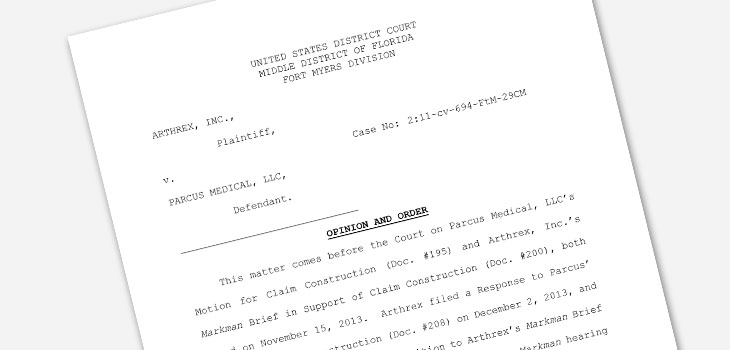
Game, set, match. Arthrex, Inc. has scored a double bagel patent victory over Parcus Medical, LLC.
Arthrex Beats Former Execs in Patent Dispute
1 min read Premium comments
Secondary
When several former high-level Arthrex executives left the company in 2007 to sell less expensive “generic” arthroscopic products, they took proprietary information with them. Arthrex sued them in December, 2001 for patent infringement.
On August 26, 2014, Arthrex announced that Parcus Medical acknowledges that certain ex-Arthrex employees took proprietary information, including product manufacturing programming and manufacturing know-how relating to Arthrex products. Parcus also acknowledges that the information was found in Parcus’ possession without Arthrex’s authorization.
The parties have agreed on remedial measures, including purging of the Arthrex proprietary information from Parcus and compensation to Arthrex.
The ‘451 Patent
Parcus also acknowledges that certain Parcus drill guides use the patented technology in Arthrex’s United States Patent No. 5, 993, 451 “Cannulated Suture Anchor Drill Guide”. The patent was issued to Dr. Stephen Burkhart and assigned to Arthrex. Parcus acknowledges that this patent is valid, and regrets the use of this technology without Arthrex’s authorization.
The court disagreed with Parcus Medical’s argument of a claim limitation and that “cylindrical handle” means “a handle that is shaped similar to a cylinder.”
Parcus Agrees to Royalties
In matters unrelated to the litigation between the parties, Parcus also admits that some of its products use Arthrex’s technology in United States Patent No. 8, 343, 186, United States Patent No. 8, 623, 052, and United States Patent No. 8, 801, 755. Parcus has now agreed to pay a royalty for the use of the patented features in these patents.
Author
React:
Discussion
This is a fascinating development. In my practice we've seen similar outcomes with the revised protocol. The key differentiator seems to be patient selection criteria. Has anyone else noticed the correlation with BMI thresholds?
Great point. I'd push back slightly on the conclusion, the sample size in the cited study is too small to draw population-level inferences. That said, the directional signal is compelling and worth a larger RCT.
We implemented a similar approach last year. Early results are promising but we're still gathering 12-month follow-up data. Happy to share our protocol if anyone is interested.
Join the conversation
Orthopedic professionals are discussing this. Sign in and upgrade to read every comment and add your voice.