
Will Payers Follow NASS’ Clinical Guidelines? Boston Hospitals to Find Out
Acid Test of NASS’ Clinical Guidelines in Boston // 100% Diagnosis of PJI Available // and More!
5 min read Premium comments
Christopher Bono, M.D., chief of spine at Brigham and Women’s Hospital, headed up the North American Spine Society (NASS) Coverage Task Force and now is putting those coverage guidelines to the test. Dr. Bono (who is also deputy editor of The Spine Journal), tells OTW, “Here at Partners Health system—namely, Massachusetts General and Brigham and Women’s Hospital—we have begun to implement the NASS coverage documents. In particular, we are applying these to lumbar fusion via a special algorithm known as PrOE. We are implementing all of the criteria and that will be used for approval or non-approval.”
Ok, but will the payers play along?
“Thus far” says Dr. Bono, “we have buy-in from Blue Cross Blue Shield so if we follow those guidelines then they should give the Partners system blanket coverage.”
“With this algorithm—which is essentially a decision tree—we are looking, for example, at lumbar fusion for stenosis with spondylolisthesis. The provider will have to answer questions like: Does a given patient have imaging findings that are in agreement with the results of the physical exam? Has he or she undergone 6-12 weeks of nonoperative treatment? We assign the patient to green (appropriate for fusion), red (inappropriate) or yellow (requires further evaluation). So a year from now we will be looking back at these and seeing how many yellows, reds, and greens were performed, why there were xyz number of reds, and who is not following the protocol.”
In the past, payers seemed to be following their own algorithm. Why would they change?
“The challenge thus far has been to convince insurers. Our initial algorithm was based on Oswestry Disability Index scores, but basing coverage on such numbers is new and insurance companies were uncomfortable with that.”
And physicians? Will they want to comply with an algorithm?
“Going forward the challenge will likely be the new relationship between physicians and hospitals. If there is a surgeon doing something marginally indicated then this algorithm will capture it; how surgeons and hospitals will handle these situations is yet to be determined.”
100% Diagnosis Rates for Periprosthetic Joint Infection?
A test for periprosthetic joint infection (PJI) that employs biomarkers is gaining ground in hospitals around the United States. The test for synovial fluid alpha defensins was developed by CD Diagnostics, Inc. in Claymont, Delaware. Carl Deirmengian, M.D., an orthopedic surgeon at the Rothman Institute in Philadelphia, who conducted much of his research with Javad Parvizi, M.D., director of research for The Rothman Institute, tells OTW, “Synovasure PJI has proven itself, not only in our studies that included 158 synovial fluid samples, but also in two independent studies. In our study comparing the leukocyte esterase (LE) test strip to the alpha defensin test, we found that the alpha defensin test accurately diagnosed 100% of patients, while the LE test was only correct 78% of the time. Particularly exciting was our finding that alpha defensin test is even accurate among patients with inflammatory diseases and those on antibiotics.”
“Zimmer has made the Synovasure PJI commercially available and we are seeing a significant adoption of the test among centers in the United States. Just last week we presented the alpha defensin results at the Scientific Meeting of the Musculoskeletal Infection Society because we had many inquiries from people who wanted to know if the test is accurate for every bacterial type. We undertook a retrospective review of 1, 937 synovial fluid samples; samples were collected from 418 surgeons in 42 states. We found that alpha defensin is consistently expressed in response to all types of bacteria, including Gram (+), Gram (-), yeast, less virulent organisms, and oral pathogens. Another question we received was whether the test would be accurate for patients who had a spacer block then reimplantation. Our ongoing studies are demonstrating a normalization of the Synovasure PJI test after treatment of the infection with an antibiotic spacer block.”
“Additionally, CD Diagnostics is also offering diagnostic tests for native infection through a pilot program and blood metal ion testing. We are also developing diagnostic tests for bacterial detection. With the greater availability of simple tests in orthopedics, as well as other fields, we hope that patients benefit from more rapid and accurate diagnoses.”
Out Patient Hips, Knees Very Doable!
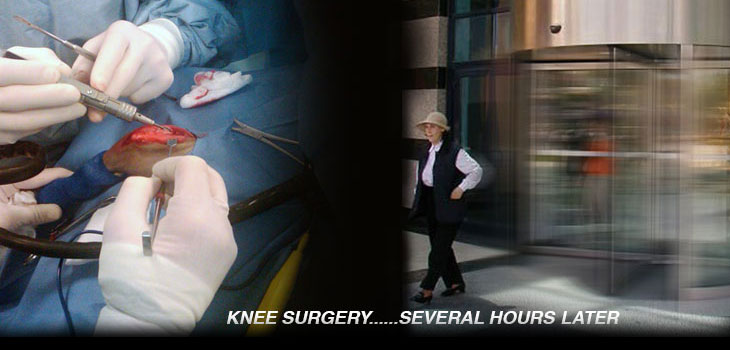
When it comes to outpatient (OP) hip and knee surgery these days, all eyes are on Adolph V. Lombardi, Jr., M.D., F.A.C.S. Along with his partners, Dr. Lombardi, president of Joint Implant Surgeons, Inc. in New Albany, Ohio, has performed over 1, 000 knee, hip, and partial knee surgeries on an outpatient basis. Dr. Lombardi tells OTW, “We have traditionally kept hip and knee patients in the hospital for 36–48 hours after total joint surgery. When I started practicing 28 years ago patients stayed for 10–15 days! Now, barring any complications, they are home in several hours. Naturally, patients are very enthusiastic about shorter length of stay.”
“It all starts with a solid patient education program, with well trained staff who begin to advise patients preoperatively. Also critical is that we have adopted new anesthetic techniques; specifically, for knee procedures, we use an adductor canal block that doesn’t block the motor component of the femoral nerve. The typical anesthesia team can be slow to adopt this type of block, but with proper training this becomes less of a problem.”
“If someone has insurance coverage, is generally healthy with no significant cardiac history or sleep apnea then they should be appropriate for these OP surgeries. The patients see an internist and we consult with other team members in order to verify that patients are meant for the OP procedure. Diabetics can undergo the surgery if their disease is under control, and if someone can get through the surgery with minimal nausea then they can go home right after the surgery. At present we cannot do these procedures in the Medicare population because there is no code for outpatient knee surgery. There is some talk about changing that, but the American Hospital Association is not fond of that idea.”
And if other institutions want to begin doing OP hip and knee surgery? “You need a dedicated anesthesiologist who wants to learn different anesthesia techniques. Also, many surgical centers are not equipped with the proper sterilization units, so that would have to be addressed. Other than that, it just requires a dedicated team of people who are interested and enthusiastic about outpatient surgery.”
“There are only about six institutions in the U.S. that are doing these surgeries. I will be giving a talk on OP surgery at the Knee Society meeting in October, however, and we expect the interest level to continue to increase.
React:
Discussion
This is a fascinating development. In my practice we've seen similar outcomes with the revised protocol. The key differentiator seems to be patient selection criteria. Has anyone else noticed the correlation with BMI thresholds?
Great point. I'd push back slightly on the conclusion, the sample size in the cited study is too small to draw population-level inferences. That said, the directional signal is compelling and worth a larger RCT.
We implemented a similar approach last year. Early results are promising but we're still gathering 12-month follow-up data. Happy to share our protocol if anyone is interested.
Join the conversation
Orthopedic professionals are discussing this. Sign in and upgrade to read every comment and add your voice.