
Zimmer Spine, Inc.’s Virage OCT Spinal Fixation System, an Occipital-Cervico-Thoracic spinal implant system, “will change surgeons’ perspective of posterior fixation.”
Zimmer Spine’s OCT Fixation System Promises to Change “Perspective”
1 min read Premium comments
Secondary
That bold statement was made by company officials on June 30, 2014, as they announced the U.S. market launch of its new spine system.
Changing surgeon perspective is a tall order. Andrew Park, M.D., director, Dallas Spine and Reconstructive Fellowship, at Baylor University Medical Center and Methodist Hospital for Surgery in Dallas, Texas, said, “This innovative posterior fixation system will enhance the experience of surgeons performing fusion procedures of the occipitocervical spine, cervical spine and the thoracic spine.”
Steve Healy, president of Zimmer Spine, said, “With the Virage OCT Spinal Fixation System, Zimmer has delivered a market-leading set of implants and instruments. This transformational technology will significantly improve the surgical flow of these procedures and will help position Zimmer Spine as a growing force in the marketplace.”
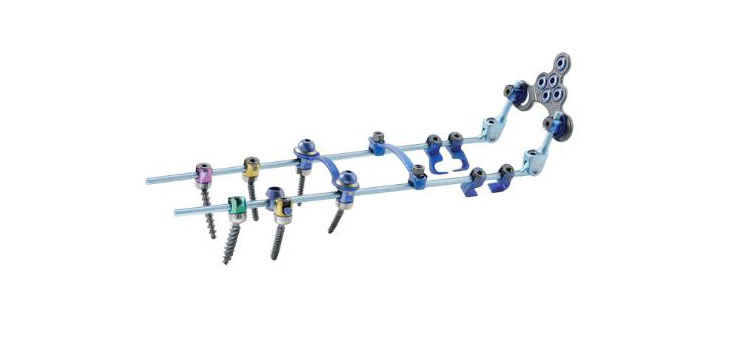
The system consists of a variety of rods, anchors, transverse connectors, screws and polyaxial screws to achieve an implant construct as necessary for the individual case. The system also includes the instruments for inserting and securing the implants.
The company statement said, “Virage, meaning a ‘change in perspective, ‘ or ‘a movement in a new direction, ‘ reflects how Zimmer’s 360° Omnidirectional Extreme-Angle Screw brings a new experience to posterior fixation surgery. All Virage System polyaxial dual-lead screws incorporate 360° Omnidirectional Extreme-Angle Screw technology, allowing for 112° of conical range of motion and simplifying rod alignment. In addition, the proprietary friction-fit screw head holds the desired rod position, facilitating rod placement.”
Author
React:
Discussion
This is a fascinating development. In my practice we've seen similar outcomes with the revised protocol. The key differentiator seems to be patient selection criteria. Has anyone else noticed the correlation with BMI thresholds?
Great point. I'd push back slightly on the conclusion, the sample size in the cited study is too small to draw population-level inferences. That said, the directional signal is compelling and worth a larger RCT.
We implemented a similar approach last year. Early results are promising but we're still gathering 12-month follow-up data. Happy to share our protocol if anyone is interested.
Join the conversation
Orthopedic professionals are discussing this. Sign in and upgrade to read every comment and add your voice.