
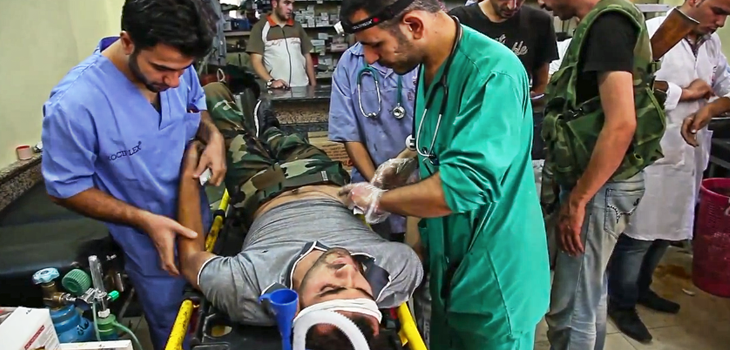
As the civil war in Syria continues unabated, the city of Zabadani remains under siege. In 2012, rebel forces entered Zabadani, a city close to Damascus. In retaliation, the Assad regime laid siege to the city by blocking all entrances and taking strategic positions in the surrounding mountains. Isolated from external aid for two years, Abdulhamid, one of the few remaining doctors, has worked tirelessly to administer to the needs of the Zabadani population.
Syrian Doctors Run Hospital Despite Siege and Civil War
2 min read Premium comments
Secondary
Abdulhamid is a 30-year-old graduate of Damascus University and has a diploma in anesthetization and resuscitation. He was completing his orthopedics residency at Damascus’ Mujtahed Hospital before the civil war began. After Assad’s forced laid siege on Zabadani, it became too dangerous for the villagers to move sick and injured civilians to nearby state-owned hospitals. Zabadani’s Medical Organization has since been founded and Abdulhamid now leads a small team of doctors and technicians.
Zabadani’s Medical Organization now supports a field hospital, a free pharmacy, and several clinics in the village. Eight doctors and 10 technicians must staff the hospital and clinic center by working in anesthetization and resuscitation, surgery, physical therapy, and the laboratory. Three nurses, an accountant, a legal adviser, and two cleaning workers assist them. The field hospital was founded by a group of activists and recently graduated doctors who wanted to aid the injured. The doctors had to pay for the equipment themselves and received little support.
As the Assad regime began targeting Zabadani in late 2011, the doctors and activists further developed the hospital with some medical aid from the Syrian Arab Crescent. Medical supplies were also smuggled from nearby state-owned hospitals. The field hospital, which started out with a few beds, now has an operating room. Clinics have opened for orthopedics and internal diseases. Most of the support for Zabadani’s Medical Organization comes from donors within the country or individuals from Zabadani who are abroad. Medical NGO’s also provide some support.
The civil war is the main cause of emergency cases, although the hospital also treats those with orthopedic traumas and internal diseases. The hospital treats an average of 125 cases each day with more than 15 additional cases at the clinics center. The center includes a pediatric clinic, internal disease clinic, and dental clinic. The dental clinic, however, is reserved only for emergency cases due to the difficulty and expenses involved in obtaining dental equipment. Zabadani’s Medical Organization also supports a physical therapy center and laboratory. All medication is offered to patients free of charge through the center pharmacy or hospital pharmacy.
The hospital staff obtains most of their supplies through the mountains on the Lebanon border. The supplies pass over secret roads or come from neighboring villages. The medical center’s current supplies are expected to last for about a month. The hospital and clinic staff members are constantly concerned about obtaining fresh supplies.
Donations for as little as $15, 000 enable this band of intrepid angels to keep operating for the next few months. Donations can be made to the Syrian American Medical Society Foundation. For online payments go to https://55974.thankyou4caring.org/. Under designation, choose “Field Hospital/Trauma Centers.” Under additional information, in the comment section, write that you would like the money to go to the Zabadani Field Hospital.
Checks can be mailed to:
SAMS Foundation
3360 Stutz Drive – Suite 100
Canfield, OH 44406
Request that the check goes to the Zabadani Field Hospital.
Author
React:
Discussion
This is a fascinating development. In my practice we've seen similar outcomes with the revised protocol. The key differentiator seems to be patient selection criteria. Has anyone else noticed the correlation with BMI thresholds?
Great point. I'd push back slightly on the conclusion, the sample size in the cited study is too small to draw population-level inferences. That said, the directional signal is compelling and worth a larger RCT.
We implemented a similar approach last year. Early results are promising but we're still gathering 12-month follow-up data. Happy to share our protocol if anyone is interested.
Join the conversation
Orthopedic professionals are discussing this. Sign in and upgrade to read every comment and add your voice.