
“Using augmented implants has not worked in the past. With this arthritic patient I would ream the high side, ” says Bill Seitz. “No, no, ” exclaims Lynn Crosby, “Augment it. He has posterior subluxation and 22 degrees of retroversion!”
Seitz, Crosby Debate Glenoid Retroversion and Asymmetric Reaming
7 min read Premium comments
Great Debates
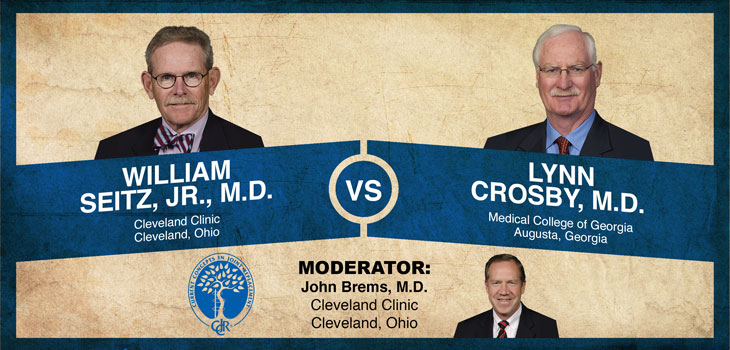
This week’s Orthopaedic Crossfire® debate is “Severe Glenoid Retroversion is Best Treated With Asymmetric Reaming.” For the proposition is William Seitz, Jr., M.D. of the Cleveland Clinic. Against the proposition is Lynn Crosby, M.D. of the Medical College of Georgia. Moderating is John Brems, M.D. of the Cleveland Clinic.
Dr. Brems: “This case involves a 58-year-old accountant who is left hand dominant and a recreational tennis player. He has a history of arthritis in his left dominant shoulder and has exhausted all nonoperative modalities. He has a minimum of 20 degrees of posterior glenoid erosion with significant bony loss.”
Dr. Seitz: “This is probably between a B2 and a C classification of glenoid posterior erosion. But there isn’t a lot of subluxation of the humeral head. Osteoarthritis in the shoulder brings with it a significant percentage of posterior wear. In order to get our implant in we need to have enough vault. So our options are to ream the high side, graft the low side, or augment the implant on the low side with some form of augmented implant.”
“The version we see in the glenoid neck can be variable and may represent the patient’s normal anatomy based on the varying sizes and shapes of their chest and spine. It’s a moving target. Should we even correct to complete neutrality when there are these other factors which affect the position of the scapula vis-à-vis the horizon? It may require maintaining some degree of persistence in retroversion to a smaller degree. Bryce (Journal of Shoulder and Elbow Surgery, 2010) showed that when there is posterior wear with subluxation posteriorly then it’s very important to ream and to balance the soft tissues.”
“From other studies we know that if we try to correct completely, we will not be able to get an implant in. Joseph Iannotti (Journal of Shoulder and Elbow Surgery, 2011) and Douglas Nowak (Journal of Shoulder and Elbow Surgery, 2009) have demonstrated that trying to completely correct any degree of retroversion greater than 15 degrees brings with it a high rate of inability to insert the implant without violating the cortex.”
“Joe Iannotti and Jason Scalise worked on the vault model and did 3D reconstructions of the shoulder to try to use a neutralized glenoid and get it as close to centered as possible, while still allowing some degree of posterior retroversion. The technique for reaming the high side isn’t difficult; if it’s less than 15 degrees then we can nearly always plane this down to neutral.”
“Using augmented implants has not worked in the past. Joe Iannotti developed a technique to try to have an augmented posterior implant. The early results were promising, but Joe has seen a failure of these implants over time. Instead, we map out the defect, planing the high side down to some degree so that we can add a bone graft. Once it’s secured with screws we can treat it like a normal glenoid and plane it down neutrally.”
“So my approach to this case would be to ream the high side; if it were at 20 degrees I would add some posterior bone graft. Since this patient didn’t have any degree of subluxation we wouldn’t go overboard, but would do an adequate release in order to keep the shoulder stable throughout a full arc of motion.”
Dr. Crosby: “Normal version in men is a slight retroversion—about 1.5 degrees; in women it’s not quite 1 degree. Posterior wear comes from a contracture of the anterior musculature, causing posterior humeral head subluxation. The results in a posterior load concentrating on the glenoid reduce the contact area, causing glenoid wear medialization and posterior instability.”
“Excessive posterior wear may appear clinically as a severely retroverted glenoid or as a bi-concave glenoid, as indicated in Walch’s classic article (Journal of Arthroplasty, 1999) on his B1/B2 type glenoids. CT scan has been determined superior to plain X-ray in measuring version. You must find the cut on the CT scan that gives you the medial aspect of the scapula and the face of the glenoid on the same cut. You draw a line from the medial side of the scapula through the center, drop a line from anterior to posterior and this gives you the retroversion.”
“As for reaming the high side, the literature recommends limits to how much eccentric reaming is possible. Farron and Gillespie say 10 degrees; Clavet and Nowak say up to 18 degrees is the recommended correction before you perforate.”
“With eccentric reaming, insufficient bone stock develops and you have to implant downsize so you’re putting a smaller glenoid on the surface. You can have perforation if you ream too much; implant loosening from the loss of subchondral support is significant. You start with a normal size glenoid and what you may end up with is a small glenoid face that you may not even be able to put a surface on.”
“The Columbia group taught us that the volume removed increases quadradically with reaming depth. A 2012 article from the Journal of Bone and Joint Surgery by the French group had five year follow up. They cemented keeled glenoids and had a 32% loosening rate.”
“Posterior augmented glenoids decrease the amount of reaming and save bone; they eliminate the need for bone graft, rebalance the joint, direct the forces down the glenoid neck, and change the shear forces to compression forces. Eccentric reaming medializes the joint, and this causes imbalance of the muscle tensioning. If you augment it you can rebalance your muscle tension and significantly increase your range of motion and balance.”
“Rice has the only real clinical article on augments (14 patients). The conclusion was that there was no benefit. They only corrected five degrees, and the correction was on the articular side. So the fixation is knocked down the neck of the glenoid. They had radiographic loosening in only one case, and no mechanical failures (this was the early augment trial by Rice from Mayo Clinic – CORR 2008). More recently, 8 and 16 augments have become available; the correction is on the nonarticular side and the joint is rebalanced because of the placement of the peg augments.”
“So far my group has 40 shoulders with an average age of 62 and an eight month follow-up. The results have been fairly predictable…all the scores have increased…the Constant is up almost 30 points from the beginning. The range of motion (ROM) has increased by 33 degrees of forward flexion and 25 degrees of active external rotation. There have been no reoperations to date and no repeat posterior subluxations.”
“So in this patient presented here today who has posterior subluxation and 22 degrees of retroversion I say ‘no’ to reaming the high side. Augment it instead!”
Moderator Brems: “Bill, do you ream over a guide pin or do it free hand?”
Dr. Seitz: “These days I ream over a guide pin. The CT scan is helpful in replicating the anatomy. Today we can get 3D printed replicas of the native bone to use as a trial. Joe Iannotti has developed patient specific techniques with a jig that fits over the glenoid based on that 3D printing and guides the guidewire exactly to the center of the glenoid. And you don’t want to take this down to subchondral bone.”
Moderator Brems: “Lynn, you talked about using a CT scan, yet in the last several years we’ve seen reports that even the best interpretive CT scan isn’t as good as a 3D CT interpretation.”
Dr. Crosby: “Correct. The literature is clear on that. It’s the positioning of the scapula…it moves a bit, so 3D corrects that.”
Moderator Brems: “If you use bone graft, which one?”
Dr. Crosby: “I’d use the humeral head if I was going to bone graft.”
Moderator Brems: “Do you use the augmented glenoid or do you prefer bone graft to plastic augmentation?”
Dr. Crosby: “Now that we have augment available we use it.”
Moderator Brems: “In reconstructing with either of your techniques how effective is it to getting the soft tissue back? It’s been stiffened, shorted…is it necessary to reestablish anatomic cuff tension as opposed to getting good soft tissue balance?
Dr. Seitz: “When you have trials in you should test and see where you need to do posterior plication anterior releases, etc…it’s that soft tissue balancing that makes a difference. But we don’t need to correct to neutral to restore what is ‘normal.’ Take a patient with kyphotic spine. There is a reason why they have posterior wear…it’s because of the position of the scapula.”
Moderator Brems: “What degree of retroversion will you accept postoperatively?”
Dr. Crosby: “Five degrees.”
Moderator Brems: “Where is the sweet spot between reaming and not having to use bone graft or the riskier techniques posteriorly where you end up with a smaller glenoid and less bone versus an anatomic glenoid and more retroversion?”
Dr. Crosby: “The problem is that these people are contracted anteriorly and can’t get their arm back to neutral. You have to balance the soft tissue and you’re going to try to do that without removing much bone. The more medially you get, then your humeral component also goes medially and you may affect your deltoid power also.”
Moderator Brems: “Bill, if you end up perforating how do you address that?”
Dr. Seitz: “There are now poly glenoids which have a trabecular type button on the back which can be implanted and you get bone ingrowth through there. If you do perforate and you’re going to cement you must be careful to keep that posterior defect covered when you cement. Otherwise, it will leak out and it won’t pressurize.”
Moderator Brems: “If you perforate would you cut a peg off?”
Dr. Crosby: “I’ll take SURGICEL and stuff it into the perforation and put bone grafts on top of that.”
Moderator Brems: “Thank you both.”
Please visit www.CCJR.com to register for the 2014 CCJR Winter Meeting, December 10 – 13 in Orlando.
Author
React:
Discussion
This is a fascinating development. In my practice we've seen similar outcomes with the revised protocol. The key differentiator seems to be patient selection criteria. Has anyone else noticed the correlation with BMI thresholds?
Great point. I'd push back slightly on the conclusion, the sample size in the cited study is too small to draw population-level inferences. That said, the directional signal is compelling and worth a larger RCT.
We implemented a similar approach last year. Early results are promising but we're still gathering 12-month follow-up data. Happy to share our protocol if anyone is interested.
Join the conversation
Orthopedic professionals are discussing this. Sign in and upgrade to read every comment and add your voice.