
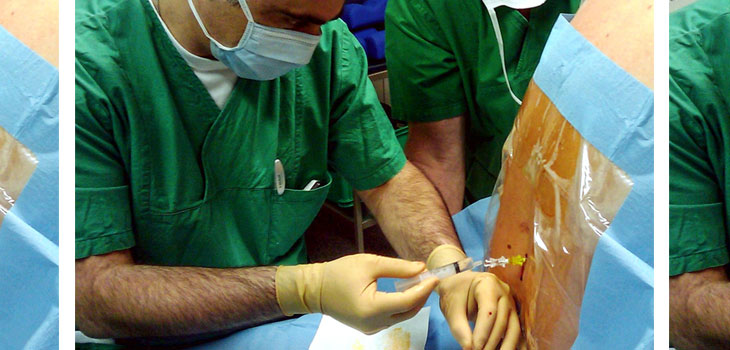
If you want to shave about eight hours off your hospital stay after getting a hip repaired, tell the doctor you want a regional rather than a general anesthetic. For a regional anesthetic, the surgeon will direct the anesthesia directly to the affected part of the body. While you will be awake and aware of the surgery, you will also be reducing your chance of death by a fraction of a percent that is so small that it is not statistically significant.
Regional Anesthetic Cuts Hospital Stays by a Third
1 min read Premium comments
Secondary
Robert Preidt, of HealthDay, reported on a study of about 57, 000 patients who had hip fracture surgery between 2004 and 2011. All were from New York State and all were over age 50. Twenty-eight percent of the patients had regional anesthesia and 72% had general anesthesia. Preidt reported that the death rate after 30 days was 5.3% for regional anesthesia patients and 5.4% for general anesthesia patients. Hospital stays were shortened by about a third of a day. The findings were published in June in the Journal of the American Medical Association.
In a related study the same group of researchers found that hip fractures, which claim 300, 000 victims each year, are twice as common among people living in nursing homes than they are elsewhere.
“This is a problem that is likely to become progressively more important as the population ages, ” said Mark Neuman, M.D., lead author of both studies and assistant professor of anesthesiology and critical care at the Perelman School of Medicine at the University of Pennsylvania, in a university news release.
Author
React:
Discussion
This is a fascinating development. In my practice we've seen similar outcomes with the revised protocol. The key differentiator seems to be patient selection criteria. Has anyone else noticed the correlation with BMI thresholds?
Great point. I'd push back slightly on the conclusion, the sample size in the cited study is too small to draw population-level inferences. That said, the directional signal is compelling and worth a larger RCT.
We implemented a similar approach last year. Early results are promising but we're still gathering 12-month follow-up data. Happy to share our protocol if anyone is interested.
Join the conversation
Orthopedic professionals are discussing this. Sign in and upgrade to read every comment and add your voice.