
RA Is a Syndrome, NOT a Single Disease
1 min read Premium comments
Secondary

" data-large-file="https://i0.wp.com/ryortho.com/wp-content/uploads/2014/07/RA_Diagram_PRINT.jpg?fit=279%2C549&ssl=1" src="https://i0.wp.com/ryortho.com/wp-content/uploads/2014/07/RA_Diagram_PRINT.jpg?resize=279%2C549&ssl=1" alt="Source: Wikimedia Commons and Rjoo317" width="279" height="549">Source: Wikimedia Commons and Rjoo317
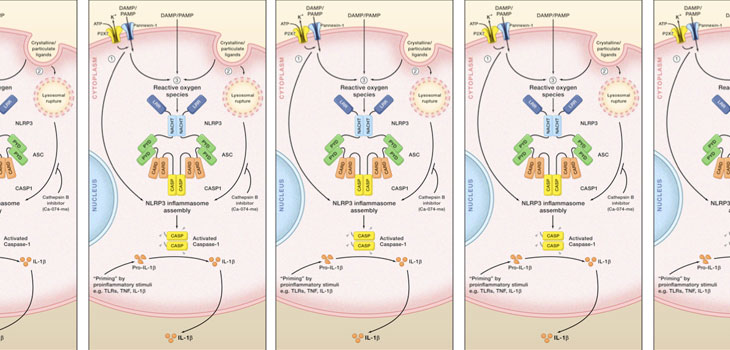
Researchers from Belgium have learned that by blocking inflammasomes, protein complexes that are suspected to play a role in the development and progression of rheumatoid arthritis (RA), they can effectively fight the progression of the disease. The team, scientists from Vlaams Instituut voor Biotechnologie (VIB) and Ghent University, have also demonstrated that RA should be considered as a syndrome rather than a single disease.
Mohamed Lamkanfi, Ph.D. of VIB/Ghent University in Belgium, commented in the July 2, 2014 news release, “Rheumatoid arthritis (RA) can be very painful and it is not always easy to find the most suitable medicine. Until recently, RA was considered to be a single disease, but our research suggests that it is more likely to be a syndrome than a single disease. This knowledge could result in a more personalized approach to treatment, with the most suitable medicines selected according to the patient’s profile.”
Lieselotte Vande Walle, a post-doctoral researcher at VIB, and Dr. Lamkanfi have been able to demonstrate the role of inflammasomes in RA using a specific mouse model with RA, developed by VIB colleagues Geert van Loo and Rudi Beyaert. Vande Walle and Lamkanfi found that by stopping the effects of interleukin-1, a protein shown to be important in inflammatory reactions, they were able to cure the mice.
Saying that RA is a syndrome rather than a single disease, the researchers indicate that this means that similar symptoms can have different causes. Thus, perhaps more personalized treatments for RA patients could be developed.
React:
Discussion
This is a fascinating development. In my practice we've seen similar outcomes with the revised protocol. The key differentiator seems to be patient selection criteria. Has anyone else noticed the correlation with BMI thresholds?
Great point. I'd push back slightly on the conclusion, the sample size in the cited study is too small to draw population-level inferences. That said, the directional signal is compelling and worth a larger RCT.
We implemented a similar approach last year. Early results are promising but we're still gathering 12-month follow-up data. Happy to share our protocol if anyone is interested.
Join the conversation
Orthopedic professionals are discussing this. Sign in and upgrade to read every comment and add your voice.