
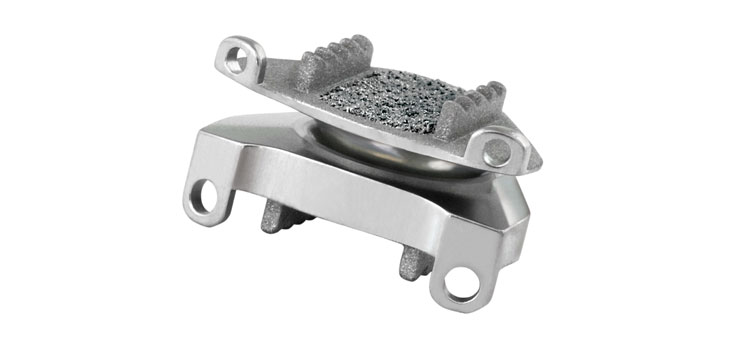
Medtronic, Inc.’s Prestige LP cervical disc has received FDA PMA (premarket application) approval.
Prestige LP Cervical Disc Approved
3 min read Premium comments
Secondary
The company announced on July 28, 2014, that the device is the third artificial cervical disc in the Medtronic’s portfolio to receive FDA approval. The original Prestige disc was introduced in 2007. The FDA has approved four other cervical discs since 2012. Globus Medical Inc.’s Secure-C and NuVasive, Inc.’s PCM were approved in 2012 and LDR received two approvals in 2013 for its Mobi-C for single- and two-level applications.
The Prestige LP is no “me-too” device, however. FDA approvals are rare and are not based on previously approved devices.
New Material and Fixation Method
According to the company, the LP is a departure from the original stainless steel Prestige in terms of materials and fixation mechanism. Instead of utilizing bone screws to attach to the vertebral bodies as in the original Prestige design, the LP design incorporates two rails positioned off midline that press-fit into two pre-drilled holes created during the surgical procedure. The LP does incorporate the same ball-and-trough articulation “designed to allow the two components to move with respect to one another in a range of motions.”
The LP disc is also different in that the disc is composed of a proprietary titanium-ceramic composite. The company says the material “has been shown to have a lower wear rate and produce less scatter on postoperative magnetic resonance imaging (MRI) than stainless steel (MR Conditional at 3 Tesla).”
Vincent Traynelis, M.D., director of Neurosurgery Spine Services and vice chairperson and professor of the Department of Neurosurgery at Rush University Medical Center in Chicago, said the goal of the device was to “maintain the same ball-and-trough articulation as in the original design, but to find a way to decrease the profile and use a material with improved postoperative MRI visualization.”
The introduction of the disc to the U.S. market “demonstrates Medtronic’s commitment to cervical arthroplasty as a viable alternative to spinal fusion in appropriate patients and illustrates our vast experience with this technology, ” added Doug King, president of Medtronic’s spinal business.
The disc has been available outside the U.S. since 2004 and has been studied in a prospective, multicenter, historical-controlled U.S. IDE [investigational device exemption] trial for a single-level indication. Risks of the disc include, “but are not limited to: early or late loosening of any or all components and development of new radiculopathy, myelopathy or pain.”
Indications
Medtronic’s LP, according to the company, “is indicated in skeletally mature patients for reconstruction of the disc at one level from C3-C7 following single-level discectomy for intractable radiculopathy (arm pain and/or a neurological deficit) with or without neck pain, or myelopathy due to a single-level abnormality localized to the level of the disc space and at least one of the following conditions confirmed by imaging (CT, MRI, X-rays): herniated nucleus pulposus, spondylosis (defined by the presence of osteophytes), and/or visible loss of disc height as compared to adjacent levels.”
“The disc is implanted using an anterior approach. Patients should have failed at least 6 weeks of non-operative treatment or have had the presence of progressive symptoms or signs of nerve root/spinal cord compression in the face of continued non-operative management prior to implantation of the disc.”
“The disc should not be implanted in patients with an active systemic infection or localized infection at the surgical site; osteoporosis defined as a DEXA bone mineral density T-score equal to or worse than -3.5 or a T-score equal to or worse than -2.5 with vertebral compression fracture, or osteopenia defined as a DEXA bone mineral density T-score <= -1.0; allergy or sensitivity to titanium, aluminum or vanadium; marked cervical instability on neutral resting lateral or flexion/extension radiographs; translation >3.5mm and/or >11° rotational difference from that of either adjacent level; severe spondylosis at the level to be treated, characterized by bridging osteophytes, loss of disc height >50%, an absence of motion (<2°) as this may lead to a limited range of motion and may encourage bone formation (e.g. heterotopic ossification, fusion); severe facet joint arthropathy; significant cervical anatomical deformity or clinically compromised vertebral bodies at the affected level due to current or past trauma (e.g., by radiographic appearance of fracture callus, malunion or nonunion) or disease (e.g., ankylosing spondylitis, rheumatoid arthritis); significant kyphotic deformity or significant reversal of lordosis; or symptoms attributed to more than one cervical level.”
Author
React:
Discussion
This is a fascinating development. In my practice we've seen similar outcomes with the revised protocol. The key differentiator seems to be patient selection criteria. Has anyone else noticed the correlation with BMI thresholds?
Great point. I'd push back slightly on the conclusion, the sample size in the cited study is too small to draw population-level inferences. That said, the directional signal is compelling and worth a larger RCT.
We implemented a similar approach last year. Early results are promising but we're still gathering 12-month follow-up data. Happy to share our protocol if anyone is interested.
Join the conversation
Orthopedic professionals are discussing this. Sign in and upgrade to read every comment and add your voice.