
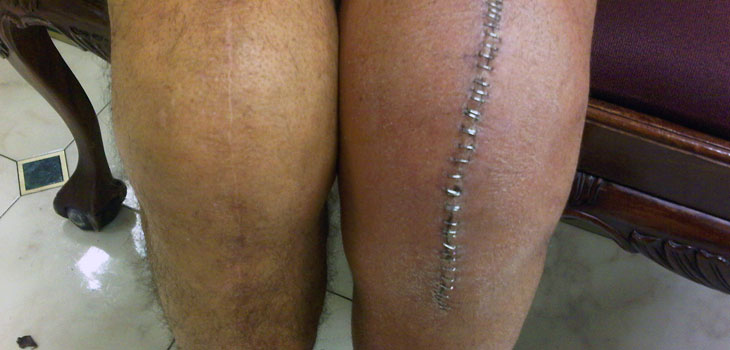
Want to survive knee surgery? Your chances may be better with a partial knee replacement. According to a new study from the University of Oxford in the UK, people who undergo total knee replacement are four times more likely to die in the first month after surgery compared to those who have a partial knee replacement, and 15% more likely to die in the first eight years.
Partial Knee Replacement Safer Than Total Knee
2 min read Premium comments
Secondary
Professor David Murray, from the Nuffield Department of Orthopaedics, Rheumatology and Musculoskeletal Sciences was the lead author on the study. And while he and his colleagues hastened to say that revision, re-operation and death were uncommon outcomes of either procedure, they indicated that patients who undergo a total knee replacement are twice as likely to have a thrombosis, heart attack or deep infection, three times as likely to have a stroke and four times as likely to need blood transfusions, compared to those having partial replacement. In addition, after total knee replacement patients are in hospital longer and the chance of being readmitted or requiring a re-operation during the first year is higher.”
The study, funded by Arthritis Research UK and the Royal College of Surgeons, also found that patients undergoing a partial knee replacement are 40% more likely to a revision surgery during the first eight years after the replacement, than those that had a total knee replacement.
Professor Murray said in the July 9, 2014 news release, “For an individual patient, the decision whether to have a partial or total is based on an assessment of the relative risks and benefits. The main benefit of the partial knee is that it provides better function.”
“The risks have been assessed in this study, which found that partial knees have fewer complications and deaths; however they do lead to more re-operations. Patients will however be more concerned to avoid death and major complications, such as heart attack or stroke, than re-operations. To put the risks in perspective, if 100 patients had a partial knee rather than a total knee replacement there would be one fewer death and three more re-operations in the first four years after surgery.”
Professor Murray added, “Patients will be concerned about death following joint replacement. However patients who have severe arthritis are very immobile and therefore tend to be unfit. Joint replacement overall, by making patients more mobile and fit tends to save lives.”
React:
Discussion
This is a fascinating development. In my practice we've seen similar outcomes with the revised protocol. The key differentiator seems to be patient selection criteria. Has anyone else noticed the correlation with BMI thresholds?
Great point. I'd push back slightly on the conclusion, the sample size in the cited study is too small to draw population-level inferences. That said, the directional signal is compelling and worth a larger RCT.
We implemented a similar approach last year. Early results are promising but we're still gathering 12-month follow-up data. Happy to share our protocol if anyone is interested.
Join the conversation
Orthopedic professionals are discussing this. Sign in and upgrade to read every comment and add your voice.