
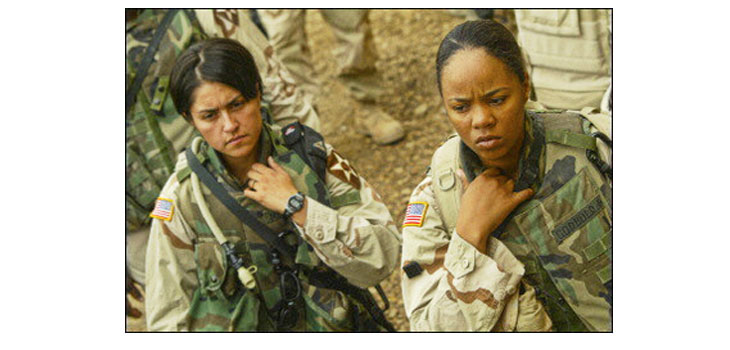
Operation Enduring Freedom (OEF) and Operation Iraqi Freedom (OIF) are unprecedented in the number of female service members present in combat zones as well as in the nature of their involvement. Women have traditionally been barred from serving in combat positions. In January 2013, the Department of Defense (DOD) rescinded that ban and female service members began carrying out a wider range of military duties. But with those new responsibilities have come increased risks of traumatic brain injury (TBI), posttraumatic stress disorder, depression, and chronic pain in female veterans.
Meeting the Health Care Needs of Female Veterans
6 min read Premium comments
In order to set the groundwork for addressing future combat-related injuries among women in the military, Jomana Amara, Ph.D.; Katherine M. Iverson, Ph.D.; Maxine Krengel, Ph.D.; Terri K. Pogoda, Ph.D.; and Ann Hendricks, Ph.D. tackled the issues of deployment of women in combat positions, the growing number of female veterans, and gender differences in an landmark article titled: “Anticipating the Traumatic Brain Injury-Related Health Care Needs of Women Veterans After the Department of Defense Change in Combat Assignment Policy.” The article appeared in the March 2014 issue of Women’s Health Issues.
“The purpose of this paper is to summarize data pertaining to current health care needs and utilization practices among women veterans to set the groundwork for estimating future combat related injuries and subsequent Veterans Health Administration [VHA] utilization. Specifically, given the relevance of the current war injuries and follow-up care, we are focusing on a high-priority health care issue for veterans, namely, traumatic brain injury, ” wrote Amara and her colleagues.
The Evolving Role of Women in the Military
In 1998, the Risk Rule “excluded women from noncombat units or missions if the risks of exposure to direct combat, hostile fire or capture were equal to or greater than the risk in the units they supported.”
In 1994, former Defense Secretary Les Aspin rescinded the Risk Rule and replaced it with the direct ground combat exclusion rule, stating that “service members are eligible to be assigned to all positions for which they are qualified except that women shall be excluded from assignment to units below the brigade level whose primary mission is to engage in direct combat on the ground.”
In January 2013, former Defense Secretary Leon Panetta rescinded the direct ground combat exclusion rule that banned women from direct ground combat positions. Although the U.S. military is far from fully integrating women into combat roles, the new policy reviewed 53, 000 positions in combat units and 184, 000 specialty positions that had previously been closed to women.
“In life, as we all know, there are no guarantees of success. Not everyone is going to be able to be a combat soldier. But everyone is entitled to a chance, ” Panetta said. “By committing ourselves to that principle, we are renewing our commitment to the American values our service members fight and die to defend.”
From 2003 to 2013, women comprised 10% to 20% of forces deployed in support of Operation Enduring Freedom and Operation Iraqi Freedom. In sheer numbers, women were nearly 300, 000 of deployed troops over that decade.
Today, female service members make up a greater proportion of U.S. military forces than ever before.
42% of Deployed Women Have Been in Combat
With a historic number of female service members in the U.S. military, an increased percentage of veterans will be comprised of women. According to the Congressional Budget Office in 2010, 203, 695 (14.4%) women were in the Active Duty forces compared to 1, 213, 675 men (85.6%). The Reserve Component that same year was comprised of 153, 071 (17.9%) women compared to 704, 186 (82.1%) men.
Not surprisingly, given the sharp increase in female service members, the number of female service members discharged after September 11, 2001, now comprises 21% of all living women veterans, while the proportion for men is 9.9%
According to the Defense Advisory Committee on Women in the Services, over half of women service members reported being deployed since 2001. Of these deployed women, half reported multiple deployments. Out of all women deployed, 42% stated that they had been involved in combat operations, compared to 58% of men. Women began serving in new and more dangerous positions in Iraq and Afghanistan, including leaving military bases, assisting combat soldiers, and coming under direct attack.
“Over more than a decade of war, they have demonstrated courage, skill and patriotism, and 152 women in uniform have died serving this nation in Iraq and Afghanistan, ” Panetta said.
VHA’s Care for Women in the Military
Under the Veterans Programs Enhancement Act of 1998, the VHA offers health services to service members who have been on active duty in combat operations, including the reserves, for a period of five years after separation from active military service. With the increase in female service members and their participation in a wider range of combat activities, the VHA is clearly faced with the task of attending to more gender-specific care.
In 2010, the Department of Veterans Affairs estimated that 70.6% of surveyed female veterans received some VHA-connected care, compared to 15.3% who received non-VHA-connected care and 12.6% who received no medical care. Of the surveyed active duty women, 51.3% indicated they intended to use the VHA as their primary source of health care upon separation from the military. Only 47.7% of active duty men indicated the same intention.
“As women have been accessing the VHA in greater numbers since OEF/OIF, it has also become apparent that they not only have different health care needs, but they are also utilizing different services than their male counterparts. Specifically, it has been found that women veterans incurred higher outpatient and overall costs, and lower inpatient medical and surgical costs, than men, ” wrote Amara and colleagues. “Given increases in women’s use of VHA care, it is essential to understand the factors that contribute to their health care utilization patterns.”
Developing Gender Specific Care
The injury most associated with Operation Enduring Freedom and Operation Iraqi Freedom is traumatic brain injury (TBI), which the Department of Veterans Affairs and Department of Defense define as a structural injury and/or disruption of brain function caused by an external force resulting in the onset or worsening of clinical signs immediately post-event. Approximately 7% to 23% of all service members deployed in Iraq and Afghanistan have experienced at least one TBI during their time there. The improvised explosive devices (IED) associated with OEF/OIF are the most prevalent cause of TBI, followed by vehicular accidents and falls.
Due to more protective body armor and advances in military medicine, many injuries are no longer fatal and increasing numbers of male and female service members are surviving TBI. However, signs of TBI may not be recognized immediately as a result of a more severe injury or if the head injury was less severe. In order to better treat TBI, the VHA mandated that all OEF/OIF veterans seeking VHA services be screened for TBI. The VHA offers a comprehensive traumatic brain injury evaluation (CTBIE) to those veterans with a positive screening.
A 2011 study by Krengel and associates examined the administrative records of 36, 106 veterans who served in Iraq and Afghanistan. Krengel determined that both men and women who underwent a CTBIE sought high levels of VHA health care. Regardless of TBI diagnosis, female veterans had higher total clinic visit rates and more medical health care visits. Women with a positive TBI diagnosis attended fewer mental health care visits in the year after their CTBIE. Other rates were similar between the genders.
Another 2011 study by Iverson and colleagues analyzed VHA administrative records for 12, 605 veterans with deployment-related TBI. Iverson found that posttraumatic stress disorder (PTSD) was the most common psychiatric disorder and women were as likely as men to develop PTSD after exposure to a blast. When compared to men, women were 2 times more likely to be diagnosed with depression, 1.3 times more likely to develop a non-PTSD anxiety disorder, and 1.5 times more likely to develop PTSD with comorbid depression. Women also reported more severe somatosensory, cognitive, and vestibular symptoms.
Both Krengel and Iverson’s studies underscore the importance of understanding and catering to the different needs of men and women with TBI as well as addressing the other conditions associated with TBI in female veterans. With an increasing number of women serving in combat, the VHA can expect more female veterans seeking services.
“If the VHA is to deliver high-quality care to all of its patients, structural changes are needed to provide the care necessary for female veterans, ” wrote Amara and colleagues. “The VHA needs to anticipate an increasing rate of utilization of outpatient services by women while simultaneously integrating the provision of medical and mental health care.
Author
React:
Discussion
This is a fascinating development. In my practice we've seen similar outcomes with the revised protocol. The key differentiator seems to be patient selection criteria. Has anyone else noticed the correlation with BMI thresholds?
Great point. I'd push back slightly on the conclusion, the sample size in the cited study is too small to draw population-level inferences. That said, the directional signal is compelling and worth a larger RCT.
We implemented a similar approach last year. Early results are promising but we're still gathering 12-month follow-up data. Happy to share our protocol if anyone is interested.
Join the conversation
Orthopedic professionals are discussing this. Sign in and upgrade to read every comment and add your voice.