
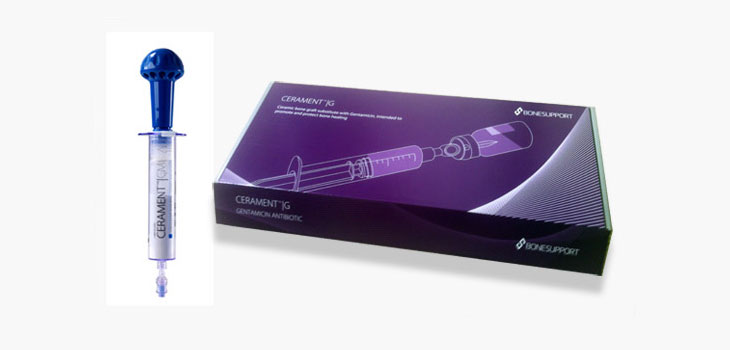
A new product designed to provide a one-stage process for dealing with bone infections is to undergo a trial at the Centre Hospitalier Universitaire Vaudois in Lausanne, Switzerland. The product is called CERAMENT™|G Bone Healing and it is made by BONESUPPORT AB of Lund, Sweden, with subsidiary locations in the United States and Germany.
Infection Fighting Bone Filler Begins Test
1 min read Premium comments
Secondary
Current methods of dealing with bone infections include debridement to remove infected tissues and provide space to give antibiotics access to the remaining pathogens. This often results in a large contaminated bony defect that must be dealt with in a second stage. The study will determine if the use of CERAMENT™|G can result in one-stage surgical revisions of bone infections.
Olivier Borens, M.D., the primary investigator, said, “ We believe the use of CERAMENT™|G will be of advantage for the patient when bone healing can be achieved with a one-stage procedure instead of a two-stage procedure, thus decreasing potential surgery-related complications.” The study will investigate the extent of the absorption and bone in-growth of CERAMENT™|G in one-stage surgical revisions of bone infections.
According to PR Newswire, which reported the study, primary endpoints of the study are CERAMENT™|G absorption and new bone in-growth. Secondary and safety endpoints are bone healing, post-operative infections and serum levels of gentamicin.
CERAMENT™|G is reported to be the first injectable antibiotic eluting bone substitute that will promote and protect bone healing that is being jeopardized by infection. The current standard of care for this condition is long-term antibiotic therapy, multiple surgical interventions and the threat of amputation.
The bone infection numbers are driven by the increasing number of prosthetic infections, diabetic ulcers, war injuries, sports injuries, and the growing resistance of the population to antibiotics.
Author
React:
Discussion
This is a fascinating development. In my practice we've seen similar outcomes with the revised protocol. The key differentiator seems to be patient selection criteria. Has anyone else noticed the correlation with BMI thresholds?
Great point. I'd push back slightly on the conclusion, the sample size in the cited study is too small to draw population-level inferences. That said, the directional signal is compelling and worth a larger RCT.
We implemented a similar approach last year. Early results are promising but we're still gathering 12-month follow-up data. Happy to share our protocol if anyone is interested.
Join the conversation
Orthopedic professionals are discussing this. Sign in and upgrade to read every comment and add your voice.