
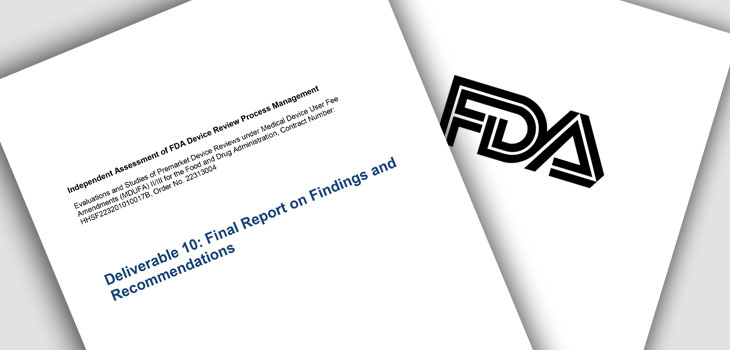
When Congress passed the Food and Drug Administration Safety and Innovation Act in 2012 to reauthorize the FDA to collect user fees from device manufacturers, the FDA and the medical device industry agreed to an independent, comprehensive assessment of the agencies medical device submission review process.
Top 11 Recommendations to Improve the FDA
2 min read Premium comments
Secondary
That assessment has been completed and recommendations have been made to improve the agency’s review process.
A June 11, 2014, Booz Allen Hamilton 147-page report offers 11 recommendations, including the need for the agency to conduct a retrospective study of withdrawn premarket approval applications to determine ways to curb such withdrawals. The report also recommends that the FDA clarify the administrative standards for 510(k) clearance applications to minimize rejections.
The recommendations cover the following five wide areas and include:
Quality Management
- Adopt a holistic, multi-pronged approach to address five quality component areas to standardize process lifecycle management activities and improve consistency of reviews (Priority Recommendation)
Evaluation of Review Process
- Develop criteria and establish mechanisms to improve consistency in decision-making throughout the review process (Priority Recommendation)
- Optimize RTA (Refuse to Accept) process by improving awareness of and clarity around Administrative requirements for 510(k) submissions
- Perform a retrospective root cause analysis of withdrawn submissions and develop a mechanism to minimize their occurrence
- Implement a consistent practice for communicating early and frequently with Sponsors during the Substantive Review phase to address and resolve potential issues prior to Substantive Interaction
Evaluation of IT Infrastructure and Workload Management Tools
- Provide mandatory training for the three primary IT systems that support MDUFA III (Medical Device User Fee Amendments) reviews (Priority Recommendation)
- Provide increased clarity to applicants beyond existing eCopy guidance to enhance organized submission structure
- Evaluate tools for providing a comprehensive view of staff workload
Evaluation of Training Programs
- FDA should identify metrics and incorporate methods to better assess review process training satisfaction, learning, and staff behavior changes (Priority Recommendation)
- Promote informal training and knowledge sharing by seasoned staff for review staff and management to share division or science-specific review processes, lessons learned, and best practices
Assessment of Staff Turnover
- Develop CDRH-wide (Center for Devices and Radiological Health) staff transition and succession plans to mitigate the impact of turnover on submission reviews
For each recommendation, Booz Allen provided suggestions for specific actions that the agency might take to address the recommendation, as resources are available. The FDA may determine at its discretion to take action on these recommendations in alternative ways.
Author
React:
Discussion
This is a fascinating development. In my practice we've seen similar outcomes with the revised protocol. The key differentiator seems to be patient selection criteria. Has anyone else noticed the correlation with BMI thresholds?
Great point. I'd push back slightly on the conclusion, the sample size in the cited study is too small to draw population-level inferences. That said, the directional signal is compelling and worth a larger RCT.
We implemented a similar approach last year. Early results are promising but we're still gathering 12-month follow-up data. Happy to share our protocol if anyone is interested.
Join the conversation
Orthopedic professionals are discussing this. Sign in and upgrade to read every comment and add your voice.