
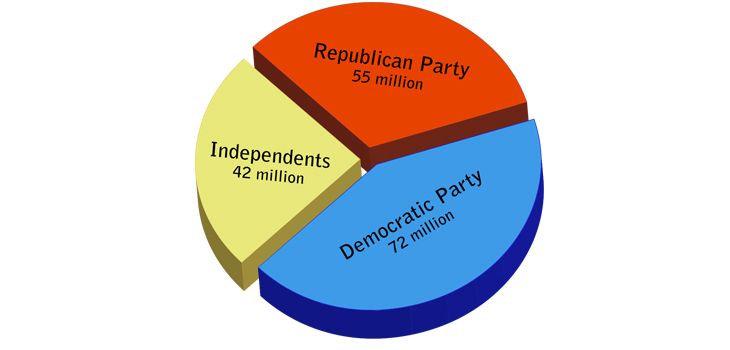
To which political party do doctors give their money—Democrats or Republicans? And is the existing pattern of donations changing? A study by the American Medical Association says that physicians are indeed becoming more political. Paul Demko, writing for Modern HealthCare and quoting the study, points out that physicians are much more likely to make political contributions now than they were two decades ago.
The Politicization of Orthopedists
1 min read Premium comments
Secondary
During the 1992 election cycle, 11, 801 doctors contributed the equivalent of $20 million to political campaigns. Two decades later, 67, 852 physicians contributed a total of $143.2 million to candidates and causes.
Demko maintains that the change is being driven by the differences in perspective between male and female doctors. An analysis of the 11 election cycles covered by the study found that 57% of the contributions from male doctors went to Republicans. During the 2012 election cycle men gave 52.3% to Republicans and women doctors gave just 23.6%.
The study found that three quarters of the contributions made by male orthopedic surgeons to political campaigns supported Republican candidates. However, only a third of male psychiatrists supported Republicans. Among women, about half of the anesthesiologists who made contributions backed Republicans, but only a quarter of female family practitioners did.
A co-author of the study, David Rothman, said, “If surgery is in your name, you’re on the Republican side. If pediatrics or psychiatry is in your name, you’re on the Democratic side.” Perhaps because 16 of the 20 physicians who serve in the U.S. House or Senate are Republicans, people assumed that doctors politically were on the right. That has changed.
Demko noted that in two of the last three election cycles, a majority of contributions made by doctors went to Democrats. If, as the study authors suspect, the gender difference is a driver of the shift, this situation will probably not change. Instead it will increase because women are making up an increasingly large share of the physician pool and are now about half of new medical school graduates.
Author
React:
Discussion
This is a fascinating development. In my practice we've seen similar outcomes with the revised protocol. The key differentiator seems to be patient selection criteria. Has anyone else noticed the correlation with BMI thresholds?
Great point. I'd push back slightly on the conclusion, the sample size in the cited study is too small to draw population-level inferences. That said, the directional signal is compelling and worth a larger RCT.
We implemented a similar approach last year. Early results are promising but we're still gathering 12-month follow-up data. Happy to share our protocol if anyone is interested.
Join the conversation
Orthopedic professionals are discussing this. Sign in and upgrade to read every comment and add your voice.