
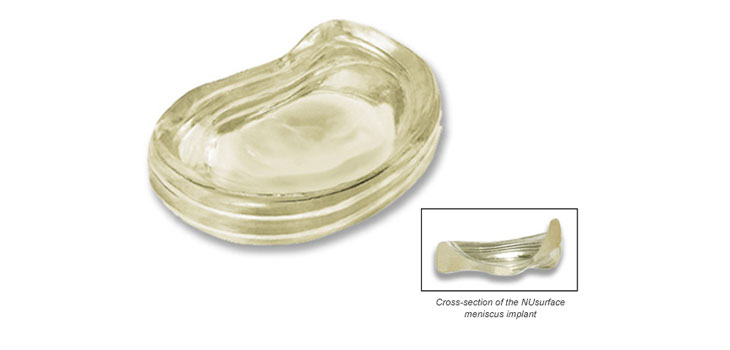
Active Implants, LLC has been granted Investigational Device Exemption (IDE) approval by the FDA to conduct a pivotal clinical trial for its NUsurface Meniscus Implant.
Polymer Meniscus Earns IDE From FDA
2 min read Premium comments
Secondary
The study is a prospective, randomized, multicenter study to demonstrate superiority of the device compared to the current standard-of-care for patients with persistent knee pain following meniscectomy surgery.
Elliott Hershman, M.D., the company’s chief medical advisor, says the device is a “novel, composite polymer implant, which is used to treat knee patients who have pain and disability arising from osteoarthritis caused by a previous meniscectomy, meniscus dysfunction or insufficiency.” He added that the device was designed to meet the needs of patients too old for meniscus repair and too young for a knee replacement. The device is implanted by orthopedic surgeons using an arthroscopic approach and a mini-open procedure and is approved in Europe under CE regulations and in Israel.
The company says in a May 29, 2014 press release that it believes the device could be used to treat several hundreds of thousands of patients a year whose earlier meniscectomy treatments have not been successful but are not yet candidates for knee arthroplasty. The potential worldwide market for the device is estimated at more than $2 billion annually.
OUS Studies
According to company Chairman and CEO Henry Klyce, clinical studies outside the U.S. (OUS) have shown that the device results in “significant pain relief and restoration of function” compared to currently available treatments.” He said the company hopes to obtain premarket approval by the FDA.
The company has been working with knee sports medicine surgeons in Belgium, Italy, Israel, The Netherlands, Sweden and Germany for the past three years conducting a prospective controlled, multi-center trial. Peter Verdonk, M.D., Ph.D., an investigator in the trial from Orthopaedic Center Monica Hospitals Antwerp and University of Ghent, Belgium, said, “I am impressed with the results observed to date and believe this technology could represent a new method of treating patients with meniscus problems who are often on a long and painful progression to knee replacement.”
$60 Million Raised
Active Implants is a privately-held, multi-national company, headquartered in Memphis, Tennessee, with additional offices in Driebergen, The Netherlands, and Netanya, Israel. The company, founded in 2004, has raised $60 million, according to press releases from their website.
Author
React:
Discussion
This is a fascinating development. In my practice we've seen similar outcomes with the revised protocol. The key differentiator seems to be patient selection criteria. Has anyone else noticed the correlation with BMI thresholds?
Great point. I'd push back slightly on the conclusion, the sample size in the cited study is too small to draw population-level inferences. That said, the directional signal is compelling and worth a larger RCT.
We implemented a similar approach last year. Early results are promising but we're still gathering 12-month follow-up data. Happy to share our protocol if anyone is interested.
Join the conversation
Orthopedic professionals are discussing this. Sign in and upgrade to read every comment and add your voice.