
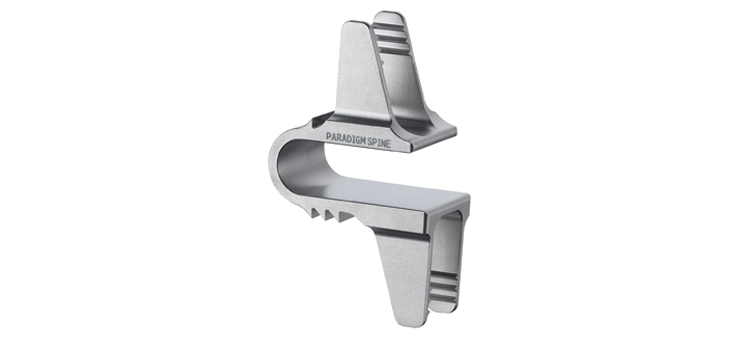
Paradigm Spine, LLC has announced the recent publication of two focal clinical research articles addressing both the costs and morbidity associated with fusion procedures performed in the treatment of spinal stenosis, and separately its comparative effectiveness relative to the company’s coflex Interlaminar Stabilization device and procedure.
Paradigm Spine: Two Articles Address Fusion, coflex Effectivenss
2 min read Premium comments
Secondary
In the recently released publication titled “Comparative Cost Effectiveness of coflex Interlaminar Stabilization Versus Instrumented Posterolateral Fusion for the Treatment of Lumbar Stenosis” published in the March 2014 edition of the Journal of Clincoeconomics and Outcomes Research, researchers suggest that the coflex Interlaminar Stabilization device and procedure is better utilized from a comparative effectiveness perspective for the treatment of lumbar spinal stenosis, when compared to instrumented spinal fusion, with savings measured over a five-year time table estimated to be approximately $11, 700 per surgical case.
In a separate publication titled “Perioperative Outcomes, Complications, and Costs Associated with Lumbar Lumbar Spinal Fusion in Older Patients with Spinal Stenosis and Spondylolisthesis” published in the June 2014 edition of the Journal of Neurosurgery Spine (JNS), researchers highlight the incidence of patients undergoing lumbar decompression and spinal fusion for the treatment of spinal stenosis and spondylolisthesis, with an emphasis on the rate of complications, cost, and readmission rates for patients receiving these treatments.
Paradigm Spine Chairman and CEO Marc R. Viscogliosi told OTW, “We believe there is an opportunity to develop additional comparative effectiveness evidence on the entire spinal stenosis disease pathology and the various treatment options that exist, and correlating those treatment options to a more well-defined algorithm of care. While we know from the compendium of literature that surgical treatment of spinal stenosis results in better QALY [quality-adjusted life year] and ICER [incremental cost–effectiveness ratio] values compared to medical management, there remains differences in opinion of which specific types of stabilization treatment options to provide in the presence of back pain, facet pathology, low grade degenerative spondylolisthesis, and even simply neurogenic claudication. We are in process of developing compelling long-term Level 1 evidence which we believe may help inform physicians, payors, policy makers and patients.”
Hallett Mathews, M.D., MBA, chief medical officer of Paradigm Spine, notes the importance of the data to assist surgeons with difficult decisions regarding patient treatment selection and the avoidance of costly mistakes. Dr. Mathews stated in the June 10, 2014 news release, “Fusion has been the mainstay of stabilization for decades now, and these studies, along with the landmark studies published by Davis, et al. in Spine, August 2013 and Davis, et al. in JNS, May 2013, prove to us that a less morbid, minimally invasive form of stabilization can occur after a decompression for the treatment of moderate to severe lumbar spinal stenosis without the need for rigid segmental stabilization with a fusion. Maintaining motion and not having to wait for arthrodesis has to be better for this patient group.’ Dr. Mathews also mentioned that “coflex and its improved outcomes and operating efficiencies combined with reduced overall costs and multiple sites of care, including the ambulatory surgery setting, truly improve value for all stakeholders.”
React:
Discussion
This is a fascinating development. In my practice we've seen similar outcomes with the revised protocol. The key differentiator seems to be patient selection criteria. Has anyone else noticed the correlation with BMI thresholds?
Great point. I'd push back slightly on the conclusion, the sample size in the cited study is too small to draw population-level inferences. That said, the directional signal is compelling and worth a larger RCT.
We implemented a similar approach last year. Early results are promising but we're still gathering 12-month follow-up data. Happy to share our protocol if anyone is interested.
Join the conversation
Orthopedic professionals are discussing this. Sign in and upgrade to read every comment and add your voice.