
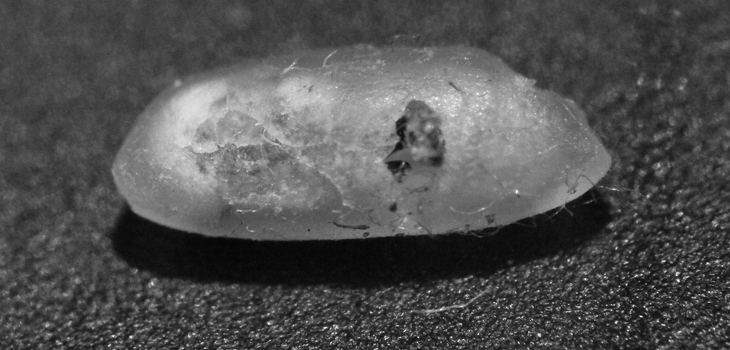
Ada Poon, Ph.D., an electrical engineer at Stanford University, has invented a way to wirelessly transfer power deep inside the human body. Poon and her team built an electronic device smaller than a grain of rice that acts as a pacemaker. The device can be powered or recharged wirelessly by holding a power source about the size of a credit card above the device, outside the body.
Pacemaker Size of Rice Grain
2 min read Premium comments
Secondary
Reported by Tom Abate for Stanford’s School of Electrical Engineering and in the Proceedings of the National Academy of Sciences, Poon’s discoveries culminate her years of effort to eliminate the bulky batteries and recharging systems that keep medical devices from being more widely used.
“We need to make these devices as small as possible to more easily implant them deep in the body and create new ways to treat illness and alleviate pain, ” said Poon. According to Abate, Poon’s central discovery is an engineering breakthrough that creates a new type of wireless power transfer—using the same power as a cell phone—that can safely penetrate deep inside the body.
Abate explains that the crux of the discovery involves a new way to control electromagnetic waves inside the body. Before Poon’s discovery, there was a clear divide between the two main types of electromagnetic waves, called far-field and near-field waves.
Far-field waves, like those broadcast from radio towers, can travel over long distances. But when they encounter biological tissue, they either reflect off the body harmlessly or get absorbed by the skin as heat. Some current medical devices, like hearing implants, use near-field technology. But they can transfer power only over short distances, limiting their usefulness deep inside the body.
What Poon did was to blend the safety of near-field waves with the reach of far-field waves by taking advantage of a simple fact—waves travel differently when they come into contact with different materials such as air, water or biological tissue. With this principle in mind, Poon designed a power source that generated a special type of near-field wave. She called this new method mid-field wireless transfer.
In the experiment, Poon used her mid-field transfer system to send power directly to tiny medical implants. It is also possible to build tiny batteries into microimplants, and then recharge these batteries wirelessly using the mid-field system. With this method Poon says that she could safely transmit power to tiny implants in organs like the heart or brain—well beyond the range of current near-field systems.
An independent laboratory that tests cell phones found that Poon’s system fell well below the danger exposure levels for human safety. She has used it to power a tiny pacemaker in a rabbit and is currently preparing the system for testing in humans.
Author
React:
Discussion
This is a fascinating development. In my practice we've seen similar outcomes with the revised protocol. The key differentiator seems to be patient selection criteria. Has anyone else noticed the correlation with BMI thresholds?
Great point. I'd push back slightly on the conclusion, the sample size in the cited study is too small to draw population-level inferences. That said, the directional signal is compelling and worth a larger RCT.
We implemented a similar approach last year. Early results are promising but we're still gathering 12-month follow-up data. Happy to share our protocol if anyone is interested.
Join the conversation
Orthopedic professionals are discussing this. Sign in and upgrade to read every comment and add your voice.