
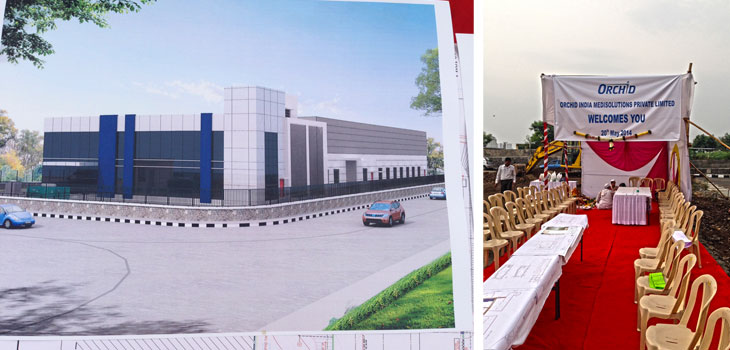
Orchid Orthopedic Solutions has announced that it will be offering expertise in machining and precision engineering at its new location in Pune, India. According to the company, Orchid India currently offers orthopedic, trauma and spine components machining and are expanding to include all the machining capabilities required to support customers in the fields of orthopedic, spinal and dental with top notch quality and service.
Orchid Breaks Ground in India
1 min read Premium comments
Secondary
The new manufacturing site—which broke ground on May 20, 2014—will be 28, 400 square feet and plans to service the Asian market as well as global customers looking for additional manufacturing options. The legal name for the new entity is Orchid India Medisolutions Private Ltd.
Jorge M. Ramos, chief administrative officer and Joe Zuzula, VP of sales and marketing were there to participate in the ceremony along with employees and local dignitaries.
“We are very proud of all the work our Asia team performed to make this dream a reality. Our customers are just as excited as we are to move into a new facility, ” said Ramos in the June 17, 2014 news release.
Asked why Pune was a good choice, Ramos told OTW, “Pune has an attractive manufacturing infrastructure that will allow us to grow quickly. Pune is about three hours east of Mumbai which offers products and people easy access to the rest of the world.”
As for the timing, Ramos commented to OTW, “The combination of a maturing market in Asia and the limited number of world-class medical device contract manufacturers in the region make this the right time to move forward.”
He added, “We expect to start moving in before the end of 2014 and be fully validated in Q1-15. The promise of a facility in India has been well received by our traditional customers and has created a spike in demand from local OEMs. We are in the process of taking orders for the new facility which will initially focus on machined components for orthopedics, trauma, spinal, dental, and endoscopy.”
Author
React:
Discussion
This is a fascinating development. In my practice we've seen similar outcomes with the revised protocol. The key differentiator seems to be patient selection criteria. Has anyone else noticed the correlation with BMI thresholds?
Great point. I'd push back slightly on the conclusion, the sample size in the cited study is too small to draw population-level inferences. That said, the directional signal is compelling and worth a larger RCT.
We implemented a similar approach last year. Early results are promising but we're still gathering 12-month follow-up data. Happy to share our protocol if anyone is interested.
Join the conversation
Orthopedic professionals are discussing this. Sign in and upgrade to read every comment and add your voice.