
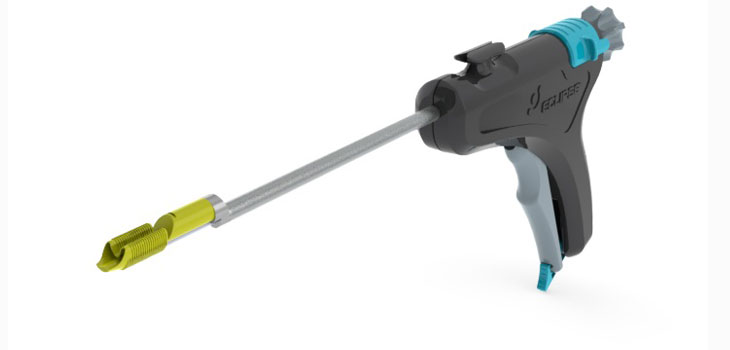
Atlanta-based MedShape, Inc. has been honored with a prestigious Medical Design Excellence Award (MDEA) for its Eclipse Soft Tissue Anchor. Since the MDEA commenced in 1998, over 600 products have received these awards.
MedShape Receives MDEA Award for Eclipse
1 min read Premium comments
Secondary
According to the Medical Device and Diagnostic Industry website, “The Medical Design Excellence Awards (MDEA) competition is the medtech industry’s premier awards program recognizing the highest caliber medical devices and diagnostic products on the market. The MDEA program recognizes the achievements of medical device manufacturers, their suppliers, and the many people behind the scenes who are responsible for the cutting-edge innovations that are saving lives; improving patient healthcare; and transforming medtech worldwide–one innovation at a time. Since its inception in 1998, the competition has honored over 600 groundbreaking products.”
According to MedShape, the Eclipse offers an innovative, nonrotational approach for reattaching soft tissue to bone. It features an expandable sheath-and-bullet design that preserves tissue orientation while reducing surgical complexity and increasing confidence in the repair.
Kurt Jacobus, Ph.D. is the chairman, president, and CEO of MedShape. Asked about milestones, he told OTW, “One significant milestone was identifying the one-sided compressed profile of the sheath as the optimal geometry to facilitate easy device insertion in procedures where the tendon lies on one side of the bone tunnel. Another milestone was scaling this expandable sheath-and-bullet design across a broad range of sizes (4 through 9 mm in diameter) to accommodate most soft tissue repair procedures.”
He added, “MedShape has established itself as an innovator in orthopedics with the Morphix Suture Anchor winning the MDEA award in 2010 and the DynaNail TTC Fusion System named as a Finalist in 2013. This new award for the Eclipse Anchor highlights MedShape’s continued efforts to develop and commercialize unique innovative products that provide significant clinical impact.”
Author
React:
Discussion
This is a fascinating development. In my practice we've seen similar outcomes with the revised protocol. The key differentiator seems to be patient selection criteria. Has anyone else noticed the correlation with BMI thresholds?
Great point. I'd push back slightly on the conclusion, the sample size in the cited study is too small to draw population-level inferences. That said, the directional signal is compelling and worth a larger RCT.
We implemented a similar approach last year. Early results are promising but we're still gathering 12-month follow-up data. Happy to share our protocol if anyone is interested.
Join the conversation
Orthopedic professionals are discussing this. Sign in and upgrade to read every comment and add your voice.