
“I think that the ultracongruent insert provides excellent posterior stability. It’s bone sparing and technically easy, there are fewer complications, and it’s certainly time saving, ” says Aaron Hofmann. “Wait, ” says Chit Ranawat. “RP-PS has better survivorship and improved ROM [range of motion] compared to fixed bearing posterior stabilized.”
Hofmann, Ranawat Debate Post in Posterior Knee
8 min read Premium comments
Great Debates
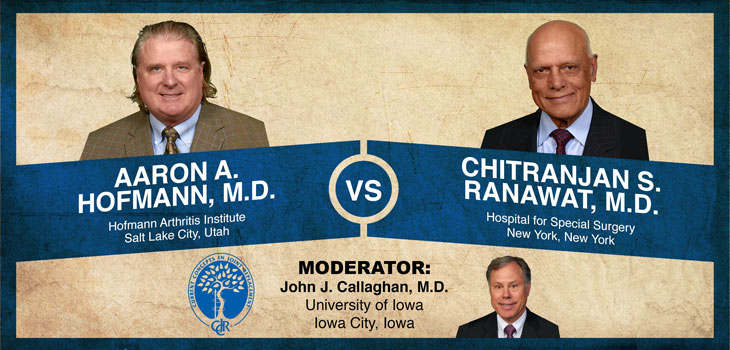
This week’s Orthopaedic Crossfire® debate is “The Posterior Stabilized Knee: No Post Required.” For the proposition is Aaron A. Hofmann, M.D. from the Hofmann Arthritis Institute in Salt Lake City; against the proposition is Chitranjan S. Ranawat, M.D. from Hospital for Special Surgery. Moderating is John J. Callaghan, M.D. from the University of Iowa.
Dr. Hofmann: “I don’t think you need a post if you have a deficient knee. If you want to save the posterior cruciate ligament (PCL) you must protect it from the saw, so I put a 1/4 inch osteotome in front of it. The problem is really the quality of the tissue you’re saving. In 1987 John Insall told us that the exact tensioning of the PCL is difficult and may depend on luck. I think I’ve begun to believe him over the years, and now I sacrifice the PCL every time.”
“When I went back and looked at my own PCL sparing (I thought) knees about eight years ago, I found that 3% of them had some posterior sag…and that they actually didn’t have a PCL. And the solution that Dr. Ranawat’s going to defend today is the posted version that came about in 1978. The named attributes of this version were improved operative exposure, ease of balancing collaterals, reduction of poly wear, greater contact area, and lower normal forces.”
“But it wasn’t all positive. We know that there are always a small number of patients with stress fractures. And there are some with dislocation (especially with the earlier designs), sometimes requiring reduction with an anesthetic.”
“Then there is the patella clunk syndrome. The fibrous tissue nodule that goes into the intercondylar notch gets stuck and clunks and catches. It’s a small incidence now, but I do occasionally see people with this issue.”
“Each week I have patients complaining about the rattle in their knees. It’s usually a little flexion laxity. I turn to the ultracongruent insert, which was conceived in 1991. It’s an extension of the total condylar, has a 12.5 mm anterior buildup, it has more congruent articulation, a higher contact area, but there is no box cut for the femur. This has been copied by at least six manufacturers and the ultracongruent insert is my favorite implant. I use this 100% of the time as opposed to the standard insert for PCL salvage.”
“Nearly 20 years ago in Seth’s lab they looked at the type of stability the PCL provided, and the ultracongruent was always above the 350lb force that the PCL provides. So I think that the ultracongruent insert provides excellent posterior stability, it’s bone sparing and technically easy, there are fewer complications, and it’s certainly time saving. We get great motion with this implant; make sure when using it that the PCL isn’t functioning because it would create a kinematic conflict. So I use flat insert trials just to be sure.”
There is no rollback just simply a congruent surface against the femur and provides great stability.
Dr. Ranawat: “Why use an ultracongruent insert? It is helpful in preventing posterior subluxation of the tibia. That occurs when there is an incompetent PCL, excessive tibial slope, and/or reduced posterior femoral offset. There are two recent publications supporting ultracongruent inserts. One from Peters in 2013 and one from Hofmann in 2010. However, two gait analysis studies from 2012 (Daniiliadis and Massin) show variable knee kinematics in flexion.”
“There is data indicating that the CR (cruciate retaining), the PS (posterior-stabilized) and RP-PS (rotating-platform posterior-stabilized) total knees will give you similar results—a failure rate of 3-4% at 10 years. But if you look at the meta analysis from Bercik (Journal of Arthroplasty 2013) it says that the CR and PS results are similar. However, range of motion (ROM) is superior with the PS knee. And there are a number of Level I and II studies showing that the RP-PS has a slight edge over the fixed bearing.”
“All good things in life ultimately prevail. If ultracongruent was the best then you would all be using it. So the total knee—no matter what kind—must have several things in order to be successful. It must be properly aligned, the soft tissue must be balanced (both in flexion and extension), the joint line must be maintained, you must size the femoral component correctly to restore offset, and you must have proper cement fixation.”
“In 2012 I published a study in the Journal of Bone and Joint Surgery on the results of the RP-PS total knee. My hypothesis was that at 10 years RP-PS should have better survivorship and improved ROM compared to fixed bearing posterior stabilized (FB-PS) total knee replacement. In 2000 I gathered 138 consecutive RP-PS knees and followed them prospectively. All of the patellae were resurfaced and all components were fixed with cement.”
“A total of eight patients were lost to follow-up and 20 had died. We examined the Knee Society Pain Score and Functional Score, ROM, the Western Ontario and McMaster Universities Arthritis Index (WOMAC), and a patient administered questionnaire. It asked if they had any knee pain in the last three months, if they had any noise in the knee, if they were satisfied with the knee, and asked about sports activities.”
“All the results on the different parameters were very good; ROM improved after surgery. Postop, 40% were still participating in sporting activities. As for the question, ‘Do you have any pain in your knee?’ 14% said ‘yes.’ The other questions: anterior knee pain (7.5%), noise and crepitation (9.4%), painful crepitation requiring scar excision (2.8%). According to the patient survey, 95% were satisfied; five patients were dissatisfied due to pain in the operative knee and in other joints. There was no spinout; three were revised (one for infection and two for fracture due to falls).”
“Radiographically, there were no radiolucent lines or loosening. Survivorship for mechanical reasons was 100%, and it was 95% for all reasons. So our results support the basic science data that the RP-PS is superior to PS. So what is the place of the ultracongruent insert with the CR knee? How many inserts are being used among all of you? If you are using an increasing amount of them then it’s a good insert. If your numbers aren’t growing, then consider RP-PS.”
Moderator Callaghan: “Aaron, a minute to tell Chit where he’s wrong.”
Dr. Hofmann: “Debating Dr. Ranawat is like debating your father…you’re just not going to win. One point, though. The ultracongruent is a kinematic mismatch if you’re saving the cruciate ligament. If you get rollback with the ultracongruent then that lip is going to go outward. You don’t save the posterior cruciate if you’re using the ultracongruent. That lip will be a kinematic conflict with the extensor mechanism. This is a sacrificing concept. And we don’t want to confuse the issue of the rotation with the rotating PS. The ultracongruent that’s rotating would be the LCS [low contact stress] knee, which is a very deep dish, conforming implant that doesn’t have a post and works exceptionally well.”
Moderator Callaghan: “Chit?”
Dr. Ranawat: “The RP-PS was designed to address spinout of the low contact stress (LCS) knee. When you have an ultracongruent, but no post, in about 1-3% there is spinout…and when that happens you need a revision. This occurs if the balance of the soft tissue sleeve in flexion is uneven. My point is that when you use a PS knee, technically it makes the operation relatively simpler. The main disadvantages of PS knees were anterior knee pain and crepitation. I believe that this has nothing to do with PS; it has to do with the location and anterior margin of the box. If you can modify the design—in the trochlear groove—then I think the incidence of this would decrease. Note that we cannot eliminate anterior knee pain after TKR [total knee replacement]. My theory is that the knee is made preferentially with innervation and blood supply—they go together intramedially. So any time you disturb that—even in a uni total knee—there are a certain percentage of patients who have anterior knee pain. This pain is due to the disturbance of the C fibers due to surgical intervention. That may also be the reason why a varus knee hurts more than a valgus knee.
Moderator Callaghan: “When did you get this revelation that you weren’t going to be a PCL retainer anymore?”
Dr. Hofmann: “When we did our first seven-year review we found out that 3% of our patients had lost their PCL (and there’s no way to predict who they are). Also, I was training fellows and they had the choice between saving the PCL or using an ultracongruent…and they all left and started using the ultracongruent because it was an easier operation. If I had a healthy PCL I would save it; it’s gotten to the point where we sacrifice it because training a lot of people makes it easier to take it.”
Moderator Callaghan: “Do you not buy that rollback is important for range of motion?”
Dr. Hofmann: “The lowest point in the ultracongruent is not dead center, so it starts posterior—6 mm posterior. So there’s already some rollback; you keep a low lip on the posterior side. These patients have fantastic ROM. My average ROM is 125 degrees.”
Moderator Callaghan: “Chit, can you go over the cause of noise and how you have come to prevent that?”
Dr. Ranawat: “The noise is caused by scar tissue, predominantly in the superior area. So you want to remove all of the synovial lining and the soft tissue around it and cauterize it. That reduces the risk of forming scar tissue. It’s a design issue…the post has to be in the right location. In the data you heard the post was too far posterior—you get better ROM with this, but you create more patellofemoral symptoms. Engagement should be around 65-70 degrees of flexion. Surgical technique is also important. In addition the anterior margin of the box is critical. In the PFC System we had to keep it there because we were converting a primary to a revision system and you need a robust box to put a bolt there.”
Moderator Callaghan: “Aaron, it can be tricky to get that insert in. Any tricks?”
Dr. Hofmann: “You must have exposure. You hyper flex the knee and dislocate the tibia anteriorly so you have a straight shot to the tibia. My technique for inserting the poly is the same no matter what style I’m using.”
Moderator Callaghan: “Thank you gentlemen.”
Please visit www.CCJR.com to register for the 2014 CCJR Spring Meeting, May 18 – 21 in Las Vegas, Nevada.
React:
Discussion
This is a fascinating development. In my practice we've seen similar outcomes with the revised protocol. The key differentiator seems to be patient selection criteria. Has anyone else noticed the correlation with BMI thresholds?
Great point. I'd push back slightly on the conclusion, the sample size in the cited study is too small to draw population-level inferences. That said, the directional signal is compelling and worth a larger RCT.
We implemented a similar approach last year. Early results are promising but we're still gathering 12-month follow-up data. Happy to share our protocol if anyone is interested.
Join the conversation
Orthopedic professionals are discussing this. Sign in and upgrade to read every comment and add your voice.