
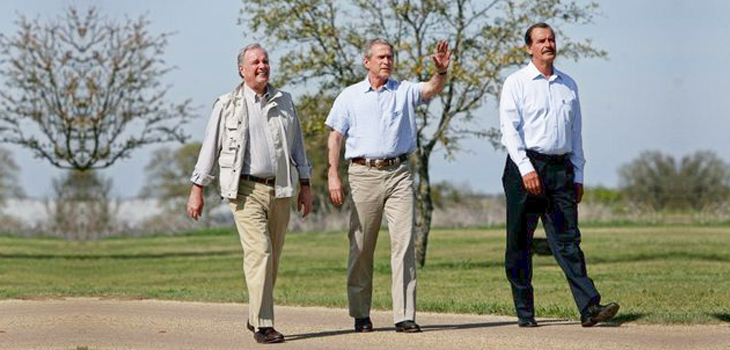
Former President George W. Bush walked around and up and down a flight of stairs hours after undergoing outpatient knee replacement surgery, according to Bush spokesman Freddy Ford.
George W. Bush Undergoes Partial Knee Replacement Surgery
1 min read Premium comments
Secondary
The 67-year-old leader had a partial knee replacement surgery at Chicago’s Rush University Medical Center on May 24, the Saturday before Memorial Day.
A partial knee replacement is performed whenever knee osteoarthritis (OA) causes knee pain, loss of range of motion, and decreased functional mobility. The OA only affects one part of the knee joint, typically the medial side, so a partial knee replacement is performed rather than a total knee replacement.
The rehab process after a partial total knee replacement involves improving knee range of motion, restoring strength of the quadriceps, hamstrings, and hips, and controlling pain and swelling around your knee. After the incision has healed, scar tissue massage and mobilization can also be performed to improve mobility of the skin and underlying tissues.
Bush stayed at a nearby hotel after the operation and flew home to Dallas on the following Monday afternoon.
After being diagnosed with runner’s knee in 2003, Bush became an avid bicyclist. While president he rode his bicycle at Camp David and at his Texas ranch. Now he leads the Warrior 100K, a ride intended to honor wounded veterans of the wars in Iraq and Afghanistan.
Wife Laura Bush and a secret service detail accompanied the former president on his medical trip to Chicago.
Author
React:
Discussion
This is a fascinating development. In my practice we've seen similar outcomes with the revised protocol. The key differentiator seems to be patient selection criteria. Has anyone else noticed the correlation with BMI thresholds?
Great point. I'd push back slightly on the conclusion, the sample size in the cited study is too small to draw population-level inferences. That said, the directional signal is compelling and worth a larger RCT.
We implemented a similar approach last year. Early results are promising but we're still gathering 12-month follow-up data. Happy to share our protocol if anyone is interested.
Join the conversation
Orthopedic professionals are discussing this. Sign in and upgrade to read every comment and add your voice.