
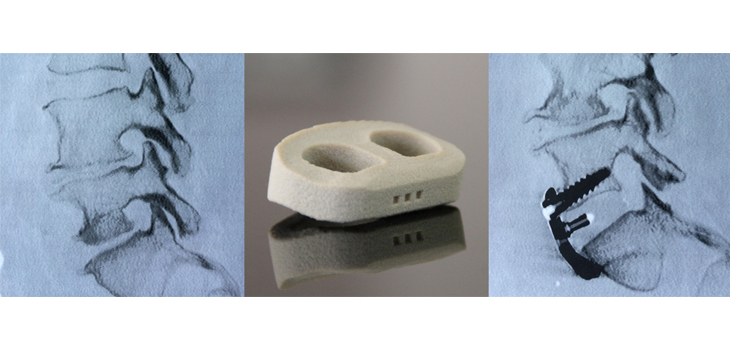
The world’s first spinal fusion surgery using customized spine cages created with a 3-D printer was performed on May 28, 2014 by Vincent Fiere, M.D. at the Hospital Jean Mermoz in Lyon, France.
First 3-D Printed Spine Cage Implanted
2 min read Premium comments
Secondary
The operation, according to a news release from French-based MEDICREA group, used the company’s UNiD ALIF intersomatic anatomical inter-body device.
Design, Record and Print
The device was developed from a 3-D digital file created from the extraction and treatment of pre-operatory scanner images of the patient, a process developed internally by the company’s R&D teams. “The company’s design, recording and production methods open the door to the future development of implantable devices that can identically reproduce the elements of the spine that need to be reinforced or replaced by artificial components printed in 3-D on implantable polymers or titanium, ” said the company statement.
Dr. Fiere said the cage, specifically ‘printed’ by MEDICREA for his patient, “positioned itself automatically in the natural space between the vertebrae and molded ideally with the spine by joining intimately with the end plates, despite their relative asymmetry and irregularity. I could also very precisely perform the restoration of the disc height and simultaneously correct the degree of lumbar lordosis using plans I had made several days before the operation with the help of MEDICREA’s Surgimap software tool.”
The device extends the company’s UNiD platform, following the launch of the UNiD pre-curved osteosynthesis rod service in Europe earlier this year.
“Continuing our trajectory since the launch of our PASS LP UNiD rods which are made to measure for each patient, MEDICREA confirms its position as the pioneer of intelligent spinal implants, perfectly adapted to the morphology of each patient’s spinal column and developed in a rational and planned manner to restore the fundamental mechanical equilibrium of the human body, ” said company President and CEO Denys Sournac. “By providing pre-planned customization, our goal is to improve patient outcomes and allow our surgeons customers to complete their plans in advance and solely focus on executing their strategy in the OR.”
MEDICREA has 120 employees with headquarters near Lyon, France. The company also has a manufacturing facility for surgical instruments and implants located in La Rochelle as well as three distribution subsidiaries in the U.S., the UK and France.
FDA Oversight
The regulatory pathway for printed devices is still in its infancy. The FDA says 3-D printed devices are treated like any other medical device. The agency has two laboratories that are looking into ways 3-D printing could affect the way medical devices are manufactured in the future.
The FDA’s Functional Performance and Device Use Laboratory uses computer-modeling methods to determine how tweaks to a medical product’s design could affect its safety and performance in various patient populations. The agency says understanding the effect of these tweaks helps the FDA evaluate devices that are customized to an individual patient or group.
The FDA’s Laboratory for Solid Mechanics focuses on how different printing methods affect the strength and durability of the materials used to make the devices. The lab’s findings “will help us to develop standards and set parameters for scale, materials, and other critical aspects that contribute to product safety and innovation, ” FDA scientists wrote in a recent blog post.
“Scan me up, Scotty.”
Author
React:
Discussion
This is a fascinating development. In my practice we've seen similar outcomes with the revised protocol. The key differentiator seems to be patient selection criteria. Has anyone else noticed the correlation with BMI thresholds?
Great point. I'd push back slightly on the conclusion, the sample size in the cited study is too small to draw population-level inferences. That said, the directional signal is compelling and worth a larger RCT.
We implemented a similar approach last year. Early results are promising but we're still gathering 12-month follow-up data. Happy to share our protocol if anyone is interested.
Join the conversation
Orthopedic professionals are discussing this. Sign in and upgrade to read every comment and add your voice.