
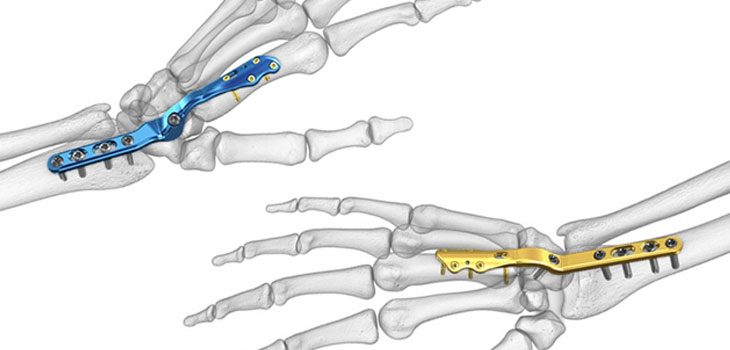
Acumed is announcing the release of its Total Wrist Fusion Plating System, which is designed to meet the needs of a variety of anatomy types. The stand-out feature? It is the only system on the market with plates specifically designed to be placed on both the second and third metacarpals.
Acumed: New Wrist Plating System for Arthritis
1 min read Premium comments
Secondary
As indicated by the company, the system—which fuses the carpal bones together—was designed to reduce the risk of soft tissue irritation associated with traditional wrist fusion plates.
“Traditional wrist fusion plates are placed on the long metacarpal with the screws placed posteriorly through the plate, potentially leaving rough edges which could cause extensor tendon irritation” says William B. Geissler, M.D. in the June 16, 2014 news release. Dr. Geissler is professor of orthopaedic surgery at the University of Mississippi Medical Center, and is the system’s design surgeon.
He added, “I wanted to work with the engineers at Acumed to design a system of wrist fusion plates that were smooth dorsally where the distal screws came in from the sides with the option to place on either the index or long metacarpal to minimize soft tissue irritation.”
According to the company, the system comes in two sizes. The plates come as left-right specific and neutral; all plates have a 15° dorsal bend, established as a balance between anatomic resting position, hand function, and grip strength.
Asked about the development process, Dr. Geissler told OTW, “It was interesting to work with the concept that [wrist fusion] plates do not have to be straight. Acumed designs plates with unique features that address the particular needs of a specific operation. In this case, we design a plate system that is smooth dorsally with screws that come in from the sides rather than straight dorsally and curves over to the index metacarpal away from the extensor tendons to decrease soft tissue irritation.”
“I hope that surgeons will report much higher patient satisfaction with significant decreased extensor tendon irritation requiring a second surgery for metal removal.”
React:
Discussion
This is a fascinating development. In my practice we've seen similar outcomes with the revised protocol. The key differentiator seems to be patient selection criteria. Has anyone else noticed the correlation with BMI thresholds?
Great point. I'd push back slightly on the conclusion, the sample size in the cited study is too small to draw population-level inferences. That said, the directional signal is compelling and worth a larger RCT.
We implemented a similar approach last year. Early results are promising but we're still gathering 12-month follow-up data. Happy to share our protocol if anyone is interested.
Join the conversation
Orthopedic professionals are discussing this. Sign in and upgrade to read every comment and add your voice.