
From Huffpost Healthy Living comes a story by Amanda Chan about a trial for an experimental knee osteoarthritis treatment in India. Running the trial was Vjay Vad, M.D., a sports medicine specialist at the Hospital for Special Surgery in New York. His treatment, called “percutaneous cartilage bone interphase optimization” (PeCaBoo) involved collecting a patient’s own stem cells and injecting them in the knee where the bone meets the cartilage.
Tiny Trial Increases Knee Cartilage 41%
1 min read Premium comments
Secondary
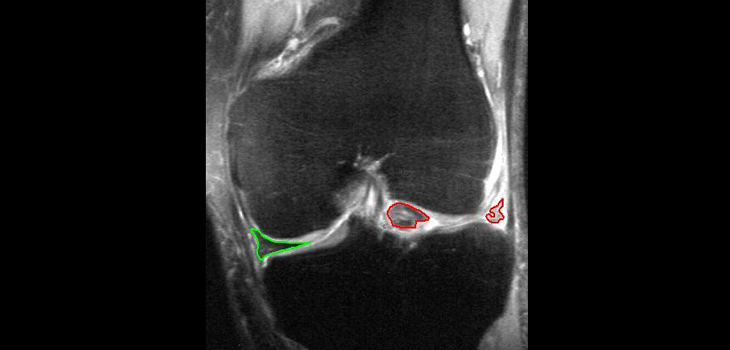
The trial, which included 10 patients and was completed through Vad’s own biotech company, Vad Scientific LLC., showed that the treatment increased cartilage matrix in the knee an average of 41%, as measured by MRI. Vad reported the results at a meeting of the European Society for Sports Traumatology, Knee Surgery and Arthroscopy.
Vad explained to HuffPost’s writer, “We’re stimulating your own bone marrow so that it spits out embryonic-like stem cells, we’re gathering those stem cells, and we’re putting them where the bone meets the cartilage.” Vad claimed this accomplished two benefits, it increased blood supply to the knee and simulated stem cell activity. He said that stem cells act like whatever cells they’re near so putting them near cartilage makes them “want to become like cartilage, ” he said. Vad noted that it remains unknown whether the stem cells turn into cartilage or a cartilage-like substance.
Vad said he hopes this new PeCaBoo method could provide another option beyond joint replacement. He told Chan, “It’s much cheaper than a knee replacement. There’s no hospitalization, [and] there’s really no issue with blood clots and pulmonary embolism of a total knee replacement, ” he said. “There’s no metal, and there’s a much smaller risk of joint infection. And last but not least, the downtime is small—you can go back to work the next day.”
Vad is planning to expand the PeCaBoo trial in India, and is working on gaining approval for a trial in the United States.
Author
React:
Discussion
This is a fascinating development. In my practice we've seen similar outcomes with the revised protocol. The key differentiator seems to be patient selection criteria. Has anyone else noticed the correlation with BMI thresholds?
Great point. I'd push back slightly on the conclusion, the sample size in the cited study is too small to draw population-level inferences. That said, the directional signal is compelling and worth a larger RCT.
We implemented a similar approach last year. Early results are promising but we're still gathering 12-month follow-up data. Happy to share our protocol if anyone is interested.
Join the conversation
Orthopedic professionals are discussing this. Sign in and upgrade to read every comment and add your voice.