
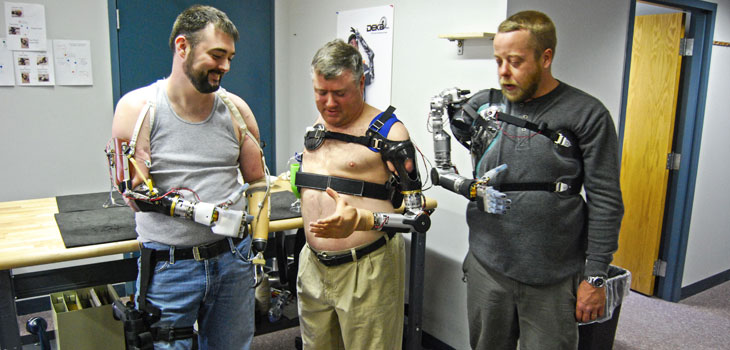
The FDA has approved the first prosthetic arm that its wearer can control with his or her own thoughts, according to John Gever, deputy managing editor of MedPage Today. The device, which is manufactured by DEKA Integrated Solutions Corp. of New Hampshire, translates electromyographic activity in muscles near the prosthesis into signals that direct specific movements in the prosthetic arm. The user of the arm can consciously control those signals.
Thought-Controlled Arm Approved by FDA
1 min read Premium comments
Secondary
A trial with 36 participants, patients in the Veterans Affairs medical system, led to the FDA approval. According to Gever’s report, the prosthetic arm is about the same size and weight as a human adult arm and is capable of making ten different movements.
Gever quotes the FDA report as stating, “The study found that approximately 90% of study participants were able to perform activities with the DEKA Arm System that they were not able to perform with their current prosthesis, such as using keys and locks, preparing food, feeding oneself, using zippers, and brushing and combing hair.”
The device appeared able to function in adverse environmental conditions and to survive impacts. It also will allow users to perform more complex tasks than are currently possible. Configurations are available for a variety of arm amputations including the loss of the entire arm up to the shoulder joint.
According to Gever’s report, the FDA has determined that failure of this device while in use would not put patients at severe risk, which allows DEKA to apply through the de novo classification process for first-in-class products.
Author
React:
Discussion
This is a fascinating development. In my practice we've seen similar outcomes with the revised protocol. The key differentiator seems to be patient selection criteria. Has anyone else noticed the correlation with BMI thresholds?
Great point. I'd push back slightly on the conclusion, the sample size in the cited study is too small to draw population-level inferences. That said, the directional signal is compelling and worth a larger RCT.
We implemented a similar approach last year. Early results are promising but we're still gathering 12-month follow-up data. Happy to share our protocol if anyone is interested.
Join the conversation
Orthopedic professionals are discussing this. Sign in and upgrade to read every comment and add your voice.