
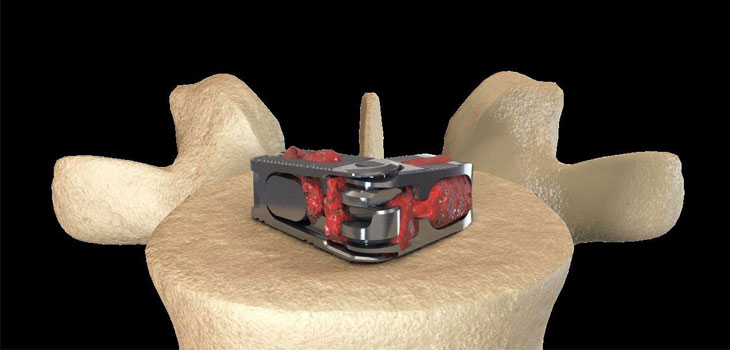
Expanding Orthopedics Inc., a venture backed, medical device company in Or Akiva, Israel, presented for the first time its new spinal cage—the FLXfit TLIF 3D—at the late April 2014 annual meeting in Miami of the International Society for the Advancement of Spine Surgery (ISASS). The new device, described as a “novel expandable and articulated intervertebral TLIF cage with optimized lordosis correction, ” is the work of three international colleagues, Professor and M.D. Jean Charles Le Huec, Klaus Schnake, M.D. and Ory Keynan, M.D.
Surgeon Trio Invents Expandable Spine Cage
1 min read Premium comments
Secondary
As Le Huec, head of the Ortho-Spine Department, Bordeaux University Hospital, France, and former president of ISASS and EuroSpine explained, “correcting anatomical balance in the lumbar spine is imperative, particularly in the lower disc spaces.” He said that current cages have limited possibilities for lordosis correction and are sometimes difficult to maneuver. In addition, he added, the contact between the implant and endplate is not always optimal, leading to improper stability after the surgery.
The third member of the design team, Schnake, head of the Spine Surgery Center at the Nurenberg Schoen Klinik, Germany, added that, “the FLXfit successfully passed all relevant international biomechanical testing, with equivalent or superior results compared to alternative devices in all measures. In cadaver studies performed with my colleagues, all cages were successfully implanted, positioned and expanded.” Schnake said that expansion of the device was easily reversed allowing for safe removal.
Ofer Bokobza, CEO of Expanding Orthopedics, said that “we are honored to have this close collaboration with a top notch group of renowned surgeons enabling our continuous release of unique minimal invasive expandable devices to the market.” The FLXfit, he said, will soon be available internationally.
Author
React:
Discussion
This is a fascinating development. In my practice we've seen similar outcomes with the revised protocol. The key differentiator seems to be patient selection criteria. Has anyone else noticed the correlation with BMI thresholds?
Great point. I'd push back slightly on the conclusion, the sample size in the cited study is too small to draw population-level inferences. That said, the directional signal is compelling and worth a larger RCT.
We implemented a similar approach last year. Early results are promising but we're still gathering 12-month follow-up data. Happy to share our protocol if anyone is interested.
Join the conversation
Orthopedic professionals are discussing this. Sign in and upgrade to read every comment and add your voice.