
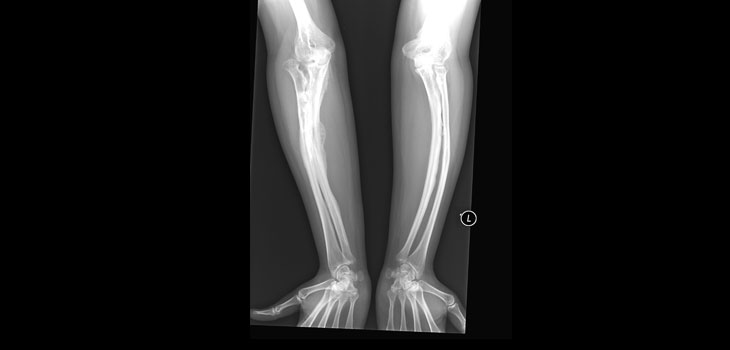
Researchers at Baylor College of Medicine have identified a new approach to treating osteogenesis imperfecta (OI), also known as brittle bone disease. Patients who have this congenital disorder live with fragile bones that break easily. The study, published in the current issue of the journal Nature Medicine, showed that excessive activity of an important signaling protein in the matrix of the bone called transforming growth factor beta is associated with the cause of the disease.
New Treatment for Brittle Bone Disease
1 min read Premium comments
Secondary
“There are many genetic causes of brittle bone disease in children and adults, ” said Dr. Brendan Lee, professor of molecular and human genetics at Baylor and a Howard Hughes Medical Institute investigator, in the May 4, 2014 news release. “We have discovered many of them but clinicians still cannot easily distinguish the different forms.”
“This identified an important concept in bone disease that while many different genetic mutations can affect the proteins in the bone matrix (like collagen) they act in a common pathway to cause the bone disease—that is they affect how signaling proteins called transforming growth factor beta (TGF) are delivered to cells in the bone. We now have a deeper understanding for how genetic mutations that affect collagen and collagen processing enzymes cause weak bones.”
In animal studies, Dr. Lee and his colleagues showed that blockade of the TGF proteins using an antibody could restore the quantity of bone in mice with different forms of brittle bone disease. Dr. Lee indicated that there are drugs in development to block this pathway in humans, so eventually the work can be translated into human studies, he said.
Dr. Lee told OTW, “We plan to perform a clinical trial using anti-TGFß antibodies in patients with severe brittle bone disease. It is going to be a phase I trial focused on safety in OI patients. We will also assess effects on bone density and bone turnover markers.”
Author
React:
Discussion
This is a fascinating development. In my practice we've seen similar outcomes with the revised protocol. The key differentiator seems to be patient selection criteria. Has anyone else noticed the correlation with BMI thresholds?
Great point. I'd push back slightly on the conclusion, the sample size in the cited study is too small to draw population-level inferences. That said, the directional signal is compelling and worth a larger RCT.
We implemented a similar approach last year. Early results are promising but we're still gathering 12-month follow-up data. Happy to share our protocol if anyone is interested.
Join the conversation
Orthopedic professionals are discussing this. Sign in and upgrade to read every comment and add your voice.