
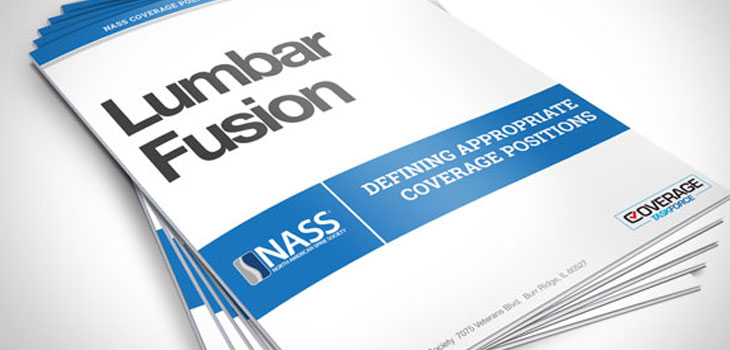
The North American Spine Society (NASS) is taking on the Milliman Care Guidelines and inappropriate insurance coverage denials by issuing its first of 13 coverage recommendations for spine procedures.
NASS Takes On Milliman and Coverage Denials
2 min read Premium comments
Secondary
The recommendations are being distributed to other medical societies and 152 insurance entities.
This is the society’s first attempt to proactively write coverage recommendations to counter Milliman or any other such guidelines and give payers a reasonable policy to adopt. To gain credibility with payers, the society has taken conservative, evidence-based approaches to coverage matters over the last several years—sometimes being criticized by some of its members for not being aggressive enough with payers.
The society is likely to get one shot with payers, so this looks like a strategic move to begin with a narrow recommendation and put the best arguments forward. Later the society can begin to chip away at other restrictive policies.
NASS President William Watters III, M.D., told his members in a May 1, 2014 letter that the society has largely been reactive, responding to shortcomings and issues with coverage policies on a case-by-case basis. Watters said it’s the society’s “strong intent and vision” that payers will use these coverage recommendations to deny “inappropriate denial of quality spine care.”
Current Coverage Topics
After an extensive review of available literature, NASS Coverage Task Force members led by Christopher Bono, M.D., developed coverage recommendations to share with payers, patients and spine care providers on the following topics:
- Cervical artificial disc replacement
- Endoscopic discectomy
- Epidural cervical spinal injections
- Interspinous device without fusion
- Interspinous fixation with fusion
- Laser spine surgery
- Lumbar artificial disc replacement
- Lumbar discectomy
- Lumbar fusion
- Lumbar laminotomy
- Lumbar spinal injections
- Percutaneous thoracolumbar stabilization
- Recombinant human bone morphogenetic protein (rhBMP-2)
Future Coverage Topics
The task force will continue to develop additional coverage recommendations. Future coverage policy recommendations include treatments, imaging/diagnostics and surgical augments for:
- Annular repair
- Cervical and Lumbar radiofrequency neurotomy
- Cervical fusion
- Cervical laminectomy
- Cervical laminoplasty
- Facet joint blocks (therapeutic and diagnostic), both cervical and lumbar intradiscal coblation treatments
- Lumbar laminectomy
- Minimally invasive lumbar fusion
- Percutaneous laminectomy (e.g. MILD)
- SI joint fusion
- SI joint injections (therapeutic and diagnostic)
- DNA-based scoliosis test
- Electrical stimulation for bone healing
NASS will revise its coverage recommendations periodically based on the availability of new evidence-based literature and the feedback received from members, patients and insurance entities. NASS strongly encourages interested parties to contact the society with any feedback and suggestions for topics for future consideration by the task force at: coverage@spine.org.
The coverage recommendations can be viewed at: https://www.spine.org/Pages/PolicyPractice/Coverage/CoverageRecommendations.aspx
Author
React:
Discussion
This is a fascinating development. In my practice we've seen similar outcomes with the revised protocol. The key differentiator seems to be patient selection criteria. Has anyone else noticed the correlation with BMI thresholds?
Great point. I'd push back slightly on the conclusion, the sample size in the cited study is too small to draw population-level inferences. That said, the directional signal is compelling and worth a larger RCT.
We implemented a similar approach last year. Early results are promising but we're still gathering 12-month follow-up data. Happy to share our protocol if anyone is interested.
Join the conversation
Orthopedic professionals are discussing this. Sign in and upgrade to read every comment and add your voice.