
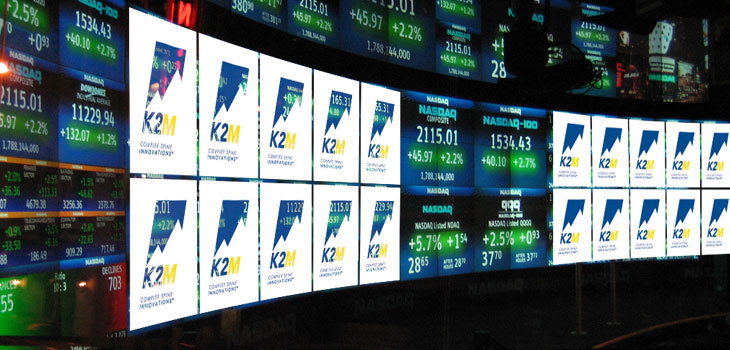
K2M Group Holdings, Inc. went live on NASDAQ on May 8, 2014 and is trading under the symbol “KTWO.”
K2M IPO Nets $120 Million
1 min read Premium comments
Secondary
The company’s initial public offering (IPO) pricing was at $15 per share for approximately 8.8 million shares. According to a company announcement, the IPO was to net approximately $120 million. A few days after the listing, the stock was trading at around $15 per share with a market cap of $427 million. That compares to a $611 million market cap to another spine company that recently went public, LDR Holding Corporation.
The net proceeds from the offering are expected to be used to retire all indebtedness outstanding under the notes held by certain of its shareholders, to repay all of the outstanding borrowings under its asset-based revolving credit facility, to pay all accumulated and unpaid dividends on its Series A redeemable convertible preferred stock and its Series B redeemable convertible preferred stock, and for working capital and general corporate purposes.
Piper Jaffray & Co., Barclays Capital Inc. and Wells Fargo Securities, LLC are acting as joint book-running managers for the offering. William Blair & Company, L.L.C. and Cowen and Company, LLC are acting as co-managers.
The company was co-founded by K2M Chairman and Chief Medical Officer John Kostuik, M.D. and President and CEO Eric Major. Welsh, Carson, Anderson & Stowe acquired controlling interest in 2010. The company nearly $157.6 million in revenue last year, but also saw a $37.9 million loss. Welsh, Carson, Anderson & Stowe will continue to own a majority of shares in the company, according to a Washington Business Journal report.
Author
React:
Discussion
This is a fascinating development. In my practice we've seen similar outcomes with the revised protocol. The key differentiator seems to be patient selection criteria. Has anyone else noticed the correlation with BMI thresholds?
Great point. I'd push back slightly on the conclusion, the sample size in the cited study is too small to draw population-level inferences. That said, the directional signal is compelling and worth a larger RCT.
We implemented a similar approach last year. Early results are promising but we're still gathering 12-month follow-up data. Happy to share our protocol if anyone is interested.
Join the conversation
Orthopedic professionals are discussing this. Sign in and upgrade to read every comment and add your voice.