
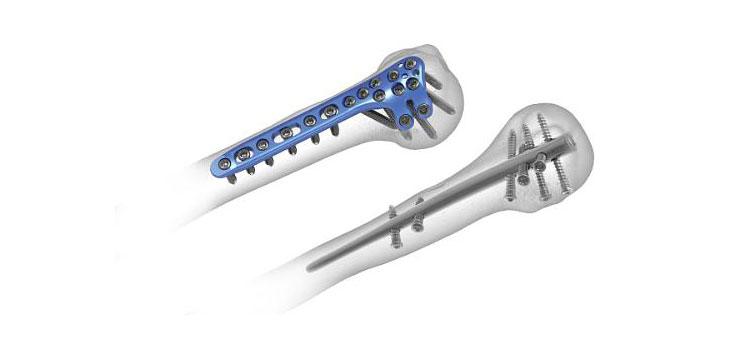
Acumed, a Hillsboro, Oregon, orthopedic firm, is introducing its new Polarus 3 Solution, a method to treat proximal humerus fractures. Acumen officials say that the device allows for a simplified operating room experience as it includes both plates and nails that use the same instrumentation and screws. They point out that the new device is a single system with multiple implants which may allow for greater intraoperative flexibility.
Acumed Upgrades Humerus Fracture Device
1 min read Premium comments
Secondary
The new system has two plate options, the Standard and the Posterior, as well as two intramedullary nail options, Proximal and Distal. The instrumentation is shared so no matter which implants the surgeon chooses—plate or nail—the single instrumentation set may be used for either implant.
The Polarus 3 Solution utilizes a single 4.3 mm low-profile hexalobe screw for both the plate and nail, which is intended to minimize inventory and alleviate confusion between screw families. Developers of the system believe that the use of a single 2.8 mm drill and driver additionally creates a more straightforward approach by removing the need for multiple sizes and diameters.
Surgeons are advised that the new plates sit lower than did the previous generation Proximal Humeral Plate so as not to impinge on the acromion (shoulder). Additionally, there are three dedicated calcar support screws intended to prevent the humerus from collapsing medially as well as more screw options in the humeral head.
Why did Acumed make the change? Rich Rice, Acumed vice president of Extremities, Trauma, and Biologics – Business Development said, “We wanted to simplify the instrumentation and offer a comprehensive system to meet the combined needs of domestic and international surgeons. In general, U.S. surgeons predominantly use plates and international surgeons tend to use intramedullary nails, but we believe the market is moving towards a mix of implants to accommodate various fracture patterns.”
Author
React:
Discussion
This is a fascinating development. In my practice we've seen similar outcomes with the revised protocol. The key differentiator seems to be patient selection criteria. Has anyone else noticed the correlation with BMI thresholds?
Great point. I'd push back slightly on the conclusion, the sample size in the cited study is too small to draw population-level inferences. That said, the directional signal is compelling and worth a larger RCT.
We implemented a similar approach last year. Early results are promising but we're still gathering 12-month follow-up data. Happy to share our protocol if anyone is interested.
Join the conversation
Orthopedic professionals are discussing this. Sign in and upgrade to read every comment and add your voice.