
Only four paralyzed patients. There was no control group. None of the four subjects regained their ability to walk. Nevertheless, the study results are remarkable because the subjects, who had complete lower-body paralysis, regained the ability to move their legs and feet voluntarily with electrical stimulation to their spinal cords.
Tiny Study – Big Potential Results
2 min read Premium comments
Secondary
MedPage Today writer John Gever reported on the study which was conducted by the University of Louisville under the direction of Claudia Angeli, Ph.D. and her colleagues. The first subject was 25–year-old Rob Summers who, in 2011, underwent seven months of electrical stimulation to his spine before he could move his lower extremities on his own. Building on their results with Summers, Angeli and her researchers enlisted three new patients who had experienced a spinal cord injury, who had been paralyzed for a least two years and who had no voluntary ability to induce movement in their lower extremities. Contrary to Summers’ experience, the three new patients found that they could move their arms, legs, feet and toes within a few days of starting the electrical treatment.
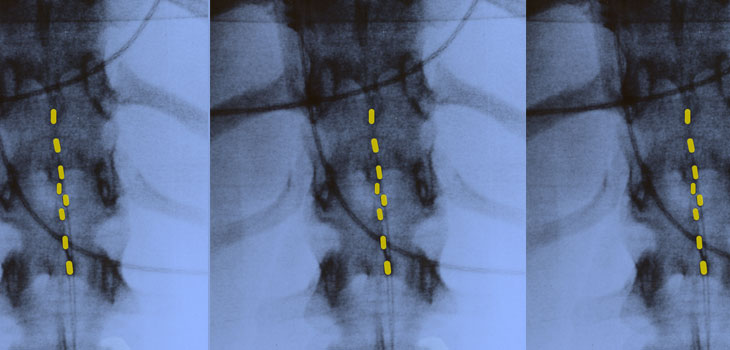
The treatment for all four patients consisted of a 16-electrode device implanted at vertebrae T11 and T12 over segments of the spinal cord L1 to S1, according the Angeli’s report which appeared online in the journal Brain. They delivered epidural stimulation at varying voltages; with frequencies of 25 or 30 Hz.
In their discussion of the study Angeli and colleagues suggested that the epidural stimulations may have awakened dormant connections: “Anatomical connections may have persisted after the injury that was previously silent because of loss of conduction as a result of disruption of myelin or the ionic channels of the neurons.”
Progress of the patients was uneven. Three of the new patients were moving their legs and feet within 11 days of beginning the stimulation while one patient achieved voluntary control in just 4 days. The subjects needed less and less stimulation as experimentation continued over several months. Eventually, one patient was able to flex his leg without the electrical stimulation. All four of the subjects were male and all had been victims of automobile accidents. One was 33-years old and the others were in their 20’s.
Author
React:
Discussion
This is a fascinating development. In my practice we've seen similar outcomes with the revised protocol. The key differentiator seems to be patient selection criteria. Has anyone else noticed the correlation with BMI thresholds?
Great point. I'd push back slightly on the conclusion, the sample size in the cited study is too small to draw population-level inferences. That said, the directional signal is compelling and worth a larger RCT.
We implemented a similar approach last year. Early results are promising but we're still gathering 12-month follow-up data. Happy to share our protocol if anyone is interested.
Join the conversation
Orthopedic professionals are discussing this. Sign in and upgrade to read every comment and add your voice.