
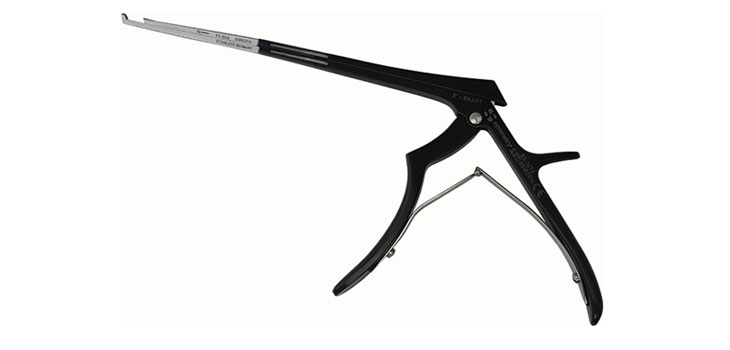
Symmetry Medical Inc. has announced that its subsidiary, Symmetry Surgical, has launched the Symmetry Sharp Kerrison, a first-of-its-kind, patented surgical instrument designed to provide a sharp tip every time. The single use tips feature a thin footplate and boasts twelve possible configurations with three reusable handle sizes and four single use, 2” tip sizes, which enable healthcare professionals to customize their optimal Symmetry Sharp Kerrison for each case.
Symmetry Medical Launches Symmetry Sharp Kerrison
1 min read Premium comments
Secondary
“Symmetry Surgical is proud to offer one of the broadest portfolios of surgical instruments in the industry. The Symmetry Sharp Kerrison is a premier addition to our already comprehensive Kerrisons portfolio, ” said Ajey Atre, President, Symmetry Surgical, in the March 31, 2014 news release. “Our Kerrisons have been staples in the industry for more than two decades. By adding to the portfolio’s rich history with today’s operating room needs of convenience and high-quality performance, Symmetry Surgical is giving healthcare professionals around the world a wide breadth of options – enabling them to choose the best surgical instruments for each case – from a single partner.
Jose Fernandez, Senior Vice President, New Product Development, told OTW, “We employed rigorous testing through the development of this project, working toward goals of patient safety and surgeon convenience. We simulated use of the Symmetry Sharp Kerrison in the most extreme conditions to ensure the patent-pending locking mechanism remained engaged during use, but quickly and easily disengaged after use. Additionally, we developed and validated proprietary methods to contaminate the device in order to evaluate the ability to clean and sterilize it – even in the most challenging conditions.”
React:
Discussion
This is a fascinating development. In my practice we've seen similar outcomes with the revised protocol. The key differentiator seems to be patient selection criteria. Has anyone else noticed the correlation with BMI thresholds?
Great point. I'd push back slightly on the conclusion, the sample size in the cited study is too small to draw population-level inferences. That said, the directional signal is compelling and worth a larger RCT.
We implemented a similar approach last year. Early results are promising but we're still gathering 12-month follow-up data. Happy to share our protocol if anyone is interested.
Join the conversation
Orthopedic professionals are discussing this. Sign in and upgrade to read every comment and add your voice.