
MedShape, Inc. is reporting new clinical outcomes pertaining to the use of its DynaNail TTC Fusion System to treat non-unions from previous hindfoot fusion procedures. In two revision cases, both performed by Daniel Latt, M.D., Ph.D., of the University of Arizona in Tucson, the patients successfully underwent revision surgery and reported no pain and a return to full activity.
MedShape: Positive Results for DynaNail
2 min read Premium comments
Secondary
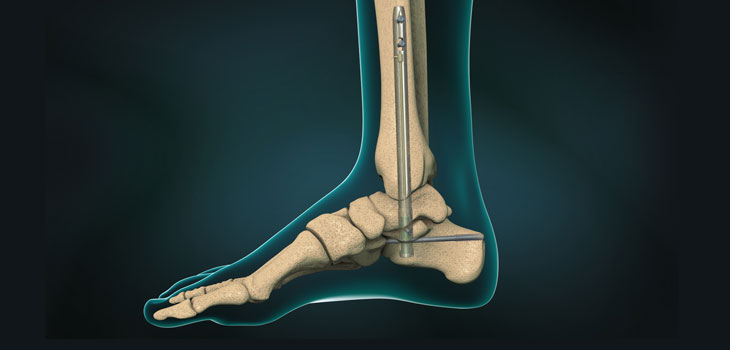
DynaNail’s internal nickel titanium (NiTiNOL) Compressive Element allows for compression to be maintained across the joint post-operatively by automatically adapting to loading changes due to settling or resorption (for up to 6 mm).
In Dr. Latt’s first case, the patient had previously undergone a subtalar arthrodesis with two headless compression screws. One year after surgery, the patient was still experiencing lateral hindfoot pain. X-ray and a CT scan revealed a non-union of the subtalar joint. The patient underwent a revision subtalar fusion in which the compression screws were removed, the arthrodesis site was filled with cancellous allograft chips mixed with iliac crest bone marrow aspirate, and a DynaNail was placed. Upon implantation, the internal Compressive Element was loaded to its full capacity allowing for adaptation up to 6 mm of resorption or settling.
At 9 weeks post-surgery, the patient had transitioned to 50% weight-bearing with no pain or swelling noted. At 12 weeks, a CT scan revealed 70% fusion around the posterior facets in the subtalar joint. After 20 weeks, the patient was walking comfortably and has since returned to daily activity (including recreational tennis).
In the second case, a diabetic patient with Charcot neuroarthropathy presented with ankle and subtalar arthritis with a severe varus deformity. The patient underwent a (tibiotalocalcaneal) TTC arthrodesis with a standard intramedullary nail. Successful fusion was achieved across the subtalar joint, but despite the use of an external bone stimulator, the ankle joint had not united leading to hardware failure. At one year after the initial surgery, it was determined that the ankle joint was unlikely to unite, and thus it was decided to proceed with a revision TTC fusion. The nail and broken screws were removed, and iliac crest bone marrow aspirate mixed with crushed cancellous allograft was used to fill the defect at the tibiotalar joint, and a DynaNail was placed with the internal Compressive Element loaded to its full capacity of 6 mm.
At 6 weeks, the wounds were well healed and the patient was experiencing no pain. The radiograph revealed that the Compressive Element had unloaded 5 mm in response to resorption and/or settling while still maintaining compression. At 8 weeks, a CT scan showed 80% fusion across the ankle joint and complete fusion across the subtalar joint. The patient was advanced to 50% weight-bearing in a boot. At 13 weeks the patient was full weight-bearing in a boot. After 7 months post-surgery, the patient was doing well with no noted pain and minimal swelling. He was walking in rocker-soled shoes without an assistive device and has returned to all of his activities.
Dr. Latt told OTW, “The DynaNail is great to work with! Its inherent stability because of the diaphyseal fit and its continuous compression from the NiTiNOL element give me unmatched confidence in tackling the toughest cases! Also, I have done another two cases, one in a varus ankle and subtalar OA [osteoarthritis] secondary to neurologic disorder from GSW [gun shot wound]. The other case was a patient with Charcot and a failed tibiocalcaneal fusion with ilizarov frame. Both great cases! Saw both patients this past week and they are both doing well.”
Author
React:
Discussion
This is a fascinating development. In my practice we've seen similar outcomes with the revised protocol. The key differentiator seems to be patient selection criteria. Has anyone else noticed the correlation with BMI thresholds?
Great point. I'd push back slightly on the conclusion, the sample size in the cited study is too small to draw population-level inferences. That said, the directional signal is compelling and worth a larger RCT.
We implemented a similar approach last year. Early results are promising but we're still gathering 12-month follow-up data. Happy to share our protocol if anyone is interested.
Join the conversation
Orthopedic professionals are discussing this. Sign in and upgrade to read every comment and add your voice.