
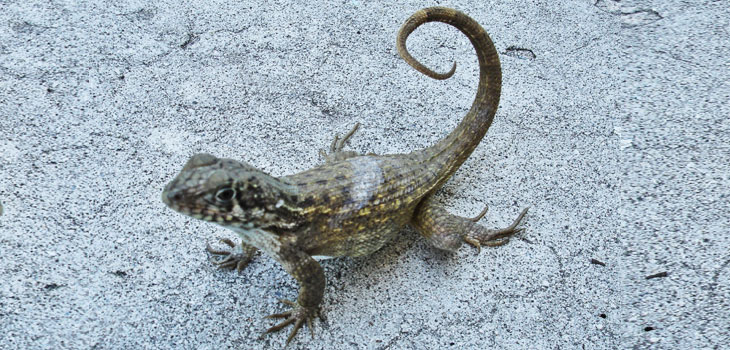
Lizards are not cuddly creatures but they can do something humans cannot—grow cartilage. If a lizard loses its tail it can regrow another one. The new tail will not have any bones in it, but the regrown cartilage will be strong enough the support the new tail.
Lizard Tails Prompt Cartilage Study
1 min read Premium comments
Secondary
The lizard’s ability to regenerate cartilage has grabbed the attention of researchers because scientists, so far, have been unable to successfully replicate this lizard cartilage-growing ability in humans.
Two of those researchers are Thomas Lozito, Ph.D. and Rocky Tuan, Ph.D. of the Center for Cellular and Molecular Engineering at the University of Pittsburgh. As reported by the Orthopaedic Research Society, Lozito explained, “We study lizard cartilage to understand how it is able to be maintained in such a robust state. We have identified several key molecules known to play roles in normal skeletal development that are turned on in unusual and interesting patterns during lizard tail cartilage growth. These molecules are responsible for the unique tissue properties of regenerated lizard cartilage.”
Lozito noted that scientists’ attempts to engineer cartilage tissue in the lab, “often results in cartilage that eventually calcifies and is replaced by bone, ” he said. This, of course, is of little help for those who suffer from degenerative joint diseases, such as osteoarthritis.
The researchers plan to examine the properties of the regenerated lizard tail that make it conducive for cartilage growth. Lozito said, “We have evidence that lizard cells themselves are particularly primed for differentiating into cartilage and that lizard cartilage itself contains a population of stem cells that readily forms new cartilage in response to trauma. This is practically the opposite of what occurs following damage to human cartilage.”
Lozito said the group’s goal is to “identify the signals and cellular properties underlying the regenerative power of lizard tail cartilage which will afford new insights into actual cartilage regeneration and potentially yield lizard-inspired therapeutics and treatments for human cartilage diseases.”
Author
React:
Discussion
This is a fascinating development. In my practice we've seen similar outcomes with the revised protocol. The key differentiator seems to be patient selection criteria. Has anyone else noticed the correlation with BMI thresholds?
Great point. I'd push back slightly on the conclusion, the sample size in the cited study is too small to draw population-level inferences. That said, the directional signal is compelling and worth a larger RCT.
We implemented a similar approach last year. Early results are promising but we're still gathering 12-month follow-up data. Happy to share our protocol if anyone is interested.
Join the conversation
Orthopedic professionals are discussing this. Sign in and upgrade to read every comment and add your voice.