
“It’s time to end the tyranny of the tibia, ” argues Mark Pagnano. “Let’s consider the femur as the prime driver of function.” “Wait, ” says Leo Whiteside. “I suggest that you get ligament balancing and alignment—both in flexion and extension—and don’t settle for anything less.”
Is a Dash of Varus/Valgus Acceptable? Pagnano v. Whiteside
8 min read Premium comments
Great Debates
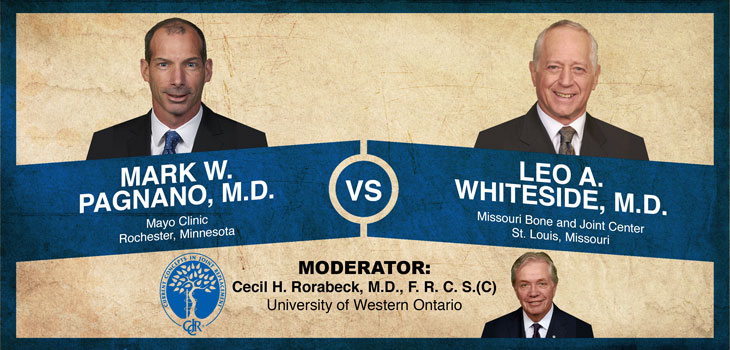
This week’s Orthopaedic Crossfire® debate is “Thou Shalt Not Commit Varus or Valgus: Challenging This Dictum.” For the proposition is Mark W. Pagnano, M.D. from Mayo Clinic in Rochester, Minnesota; against the proposition is Leo A. Whiteside, M.D. from The Missouri Bone and Joint Center in St. Louis. Moderating is Cecil H. Rorabeck, M.D., F. R. C. S.(C) from the University of Western Ontario.
Dr. Pagnano: “It’s time to end ‘the tyranny of the tibia.’ Historically in TKA [total knee arthroplasty] our main focus has been on the durability of the construct. That was appropriate because the early designs had some problems. Most of our surgeries 30 years ago were for marked deformities in older patients with low demands or for RA [rheumatoid arthritis]. Now we tend to deal with smaller deformities and shorter hospital stays; the overall risks associated with TKA are substantially different than 20-30 years ago.”
“Moving forward I think that we should devote more attention to the function part of TKA and maybe a bit less to durability. There’s been lots of interest in the last five years in identifying the ‘satisfaction gap’ between TKA and THA [total hip arthroplasty], recognizing that a subset of TKA patients are not satisfied. Surgeons have many thoughts on how to improve function after TKA…with computers, ligament tensioning devices, new implant designs.”
“The typical tibia is in slight varus, but there is substantial variability from some degree of valgus to marked degrees of varus. The typical femur is in 5-10 degrees of valgus, but that is variable.”
“When we go to a total knee replacement we tend to take a monolithic approach. We cut the tibia perpendicular to its long axis and we cut the femur perpendicular to the mechanical axis. This often results in a 5 to 6 degree valgus angle, but that varies. I contend that the 3D position of the femoral component in space is the prime driver of TKA function; by that I mean the size, the rotation, the joint line, extension and flexion, and the position of the trochlea. I contend that we systematically get this position wrong in most total knee replacements.”
“For three decades of TKA surgery the tibia has ruled. The goal has been to cut the tibia at 90 degrees (zero degree varus or valgus), and to minimize the thickness of the bone you cut. When you follow these dictates you have unintended consequences that occur on the femoral side that I believe ultimately impair the best function of a TKA.”
“Why have these rules emerged over the last three decades? First, zero degrees varus/valgus on the tibia; in the early 1980s some total knee designs failed when the tibia was in more than three degrees of varus. And why a minimal thickness cut? Because in the 1980s, biomechanics suggested that a weaker tibial bone resulted in greater levels of resection.”
“What’s wrong with these? Most are based on old knee designs, so today many knee replacements have good coronal plane conformity and have done alright in mild varus and valgus. Also, the early total knees had few sizes on the tibia, so that meant many tibial components were undersized. So it’s not surprising that some of those undersized, mal-aligned components failed. The unintended consequences: if you cut it at zero—and most knees are in a mean of three degrees of varus—you end up over-resecting the lateral side in both extension and flexion. Then that dictates changes on the femur. You have to under-resect laterally or do a medial release…and you must add more external rotation in flexion.”
“If those changes aren’t made on the femur, then in most knees the lateral side will be lax and will result in varus tilt. The minimal tibial cut also causes relatively tight extension and flexion gaps. So most surgeons cut a bit more distal femur than the thickness of the implant, and they tend to undersize the femur to make more room in flexion. These biases are often built into the instruments that we use today. So systematically in a varus knee we over-resect the femur medially in extension and flexion. We change the joint line position in extension and flexion, underestimate the AP size of the femur…all to compensate for a minimal thickness cut of the tibia at 90 degrees.”
“We should explore a new paradigm where the femur assumes the most importance and we try to reproduce a patient’s native femoral anatomy, at least within some limits…and make the tibia accommodate the femur. That perfectly sized femur has to be positioned ideally. Then we can match the valgus angle to the native femoral anatomy; we also want to match the AP size. And we want to make the femoral rotation as close to native anatomy as possible. Compared to a typical knee this will result in a knee that’s in slight valgus, an AP size that’s slightly bigger, and a slightly distal joint line.”
“So modern TKA is durable enough to let us explore new ways to get better function…and one approach is to consider the femur as the prime driver of function.”
Dr. Whiteside: “The goal should be to achieve ligament balancing and alignment—both in flexion and extension—and you should not settle for anything less. I discovered a long time ago that if you put a rod in the femur and one in the tibia, cut the tibia perpendicularly and cut the femur at 5 to 7 degree valgus, you will achieve proper alignment most of the time. I suggest that you never slope the tibia because just a couple of extra degrees might make a difference. Aim for the center and then you will accept a bit of error. Clinically, that little bit of error is often just right.”
“As for flexion, the tibia points through the patellar groove and toward the lateral aspect of the femoral head. Dr. Arima and I found that the AP axis (1995, JBJS) was easily located. What’s the difference between the AP axis and the epicondylar axis? You can’t miss the AP axis; the epicondylar axis…you can’t find it.”
“Using an intramedullary rod for the varus knee leads you to resect and correct the femur; with an intramedullary rod in the tibia you can resect and correct the tibia. When in flexion you can use the AP axis; if you cut perpendicular to it then that will take the error out of the knee. Using bone landmarks will give you about equal loads medially and laterally. If you put it in a little too much varus, you may end up with high loading on the medial side, no loading on the lateral side, and a buckling, messy knee. So do your bone cuts first, followed by ligament balancing. Anybody can find a tight ligament and poke at it until it corrects.”
“With a valgus knee, the AP axis is particularly handy because it gives you correct alignment in flexion. I’d suggest using intramedually alignment rods and drawing the AP axis. If you take the foot out of the holder and hold the knee in correct alignment, that shows you that the AP axis points toward the floor. And you want to make the tibia point toward the floor as well (in flexion). The good thing about anatomic landmarks is that they allow you to correct these deformities separately so that posteriorly you may not have much correction to make on the femur.”
“So don’t settle for less than aligned in extension and flexion, and ligaments balanced in flexion and extension.”
Moderator Rorabeck: “Dr. Pagnano, would you like to rebut?”
Dr. Pagnano: “It’s a relatively nuanced approach. I’m not proposing any major things that would go against those principles. But small changes are necessary if we’re going to improve things for that sub-group of 15-20% of knee replacements that don’t work well. Leo’s technique of picking these landmarks works most of the time—85% is what our satisfaction data tells us. So if we want to look at things over the next 3/5/7 years I don’t think we can just repeat the same things. The group that is the most responsive to any technique are the patients that are in the greatest degrees of varus and valgus.”
Moderator Rorabeck: “Leo?”
Dr. Whiteside: “I can appreciate Mark’s way of looking at things, but I think it’s risky. Finding correct alignment and doing correct ligament balancing works in 100% of cases, not 85%. We should not be saying, ‘Well, I’m going to do a little constitutional varus…I’ll tilt the tibia down three degrees.’ You won’t be happy as the carpenter redoing your kitchen says, ‘I’m going to leave your floor sloped in a constitutional north-south direction.’”
Moderator Rorabeck: “Nothing works 100% of the time.”
Dr. Whiteside: “Measurement is something that you must do 100% of the time; there will be errors that are acceptable within tolerance of measurement. Occasionally you will have tolerance stacking. So if you accept three degrees of varus on the tibia, that will actually go into five degrees. Then you say, ‘I’ll take three degrees of valgus on the femur.’ That turns into zero. Then you have a crooked knee. Measure for perfect alignment and ligament balance; then you have to accept some deviation.”
Moderator Rorabeck: “Mark, you might be leaving the odd knee in varus. Is that ever acceptable?”
Dr. Pagnano: “It’s acceptable in the sense that even in Leo’s hands he is aiming for the middle, but he occasionally leaves a knee in some degree of varus/valgus. Over time we are trying to slant the patients in the direction that’s going to give them the best level of function. So some knees probably do deserve to be in a slight amount of valgus/varus. We did a 15 year study looking at three modern total knee designs. At 15 years we couldn’t show a difference in survival rates in knees that were zero +/- three versus slightly outside that range.”
Dr. Whiteside: “I agree that a little bit of error is acceptable. Plus or minus three degrees is just tolerance stacking of 1.5 degree error on each bone.”
Moderator Rorabeck: “The take home message?”
Dr. Pagnano: “Today it’s reasonable to do things like Leo said, but we should support research efforts that look at efforts to care for that last 15% of patients.”
Moderator Rorabeck: “Thank you.”
Please visit www.CCJR.com to register for the 2014 CCJR Spring Meeting, May 18 – 21 in Las Vegas, Nevada.
React:
Discussion
This is a fascinating development. In my practice we've seen similar outcomes with the revised protocol. The key differentiator seems to be patient selection criteria. Has anyone else noticed the correlation with BMI thresholds?
Great point. I'd push back slightly on the conclusion, the sample size in the cited study is too small to draw population-level inferences. That said, the directional signal is compelling and worth a larger RCT.
We implemented a similar approach last year. Early results are promising but we're still gathering 12-month follow-up data. Happy to share our protocol if anyone is interested.
Join the conversation
Orthopedic professionals are discussing this. Sign in and upgrade to read every comment and add your voice.